

Two months after a hair transplant, many patients look in the mirror and see less hair than before surgery. This is the stage where most panicked messages to clinics are written, and the stage where online forums are least helpful. Here is what is really falling out, how often it happens, how long it lasts and the few signs that point to something other than shock loss.
Around week eight after a hair transplant, a large share of patients go through the same moment: the new hairline has disappeared, the hair around it looks thinner than it did before surgery, and every shower leaves more hair in the drain. The natural conclusion is that something went wrong. In most cases nothing did.
Two different processes overlap in this period, and they are often lumped together under one name. One is the expected shedding of the transplanted hairs. The other is shock loss: the temporary fall of your own, native hair caused by the stress of surgery. Understanding the difference is what turns month two from a crisis into a waiting room. This guide covers shock loss after a hair transplant in detail; for the full 12-month picture, see our hair transplant before and after, month by month.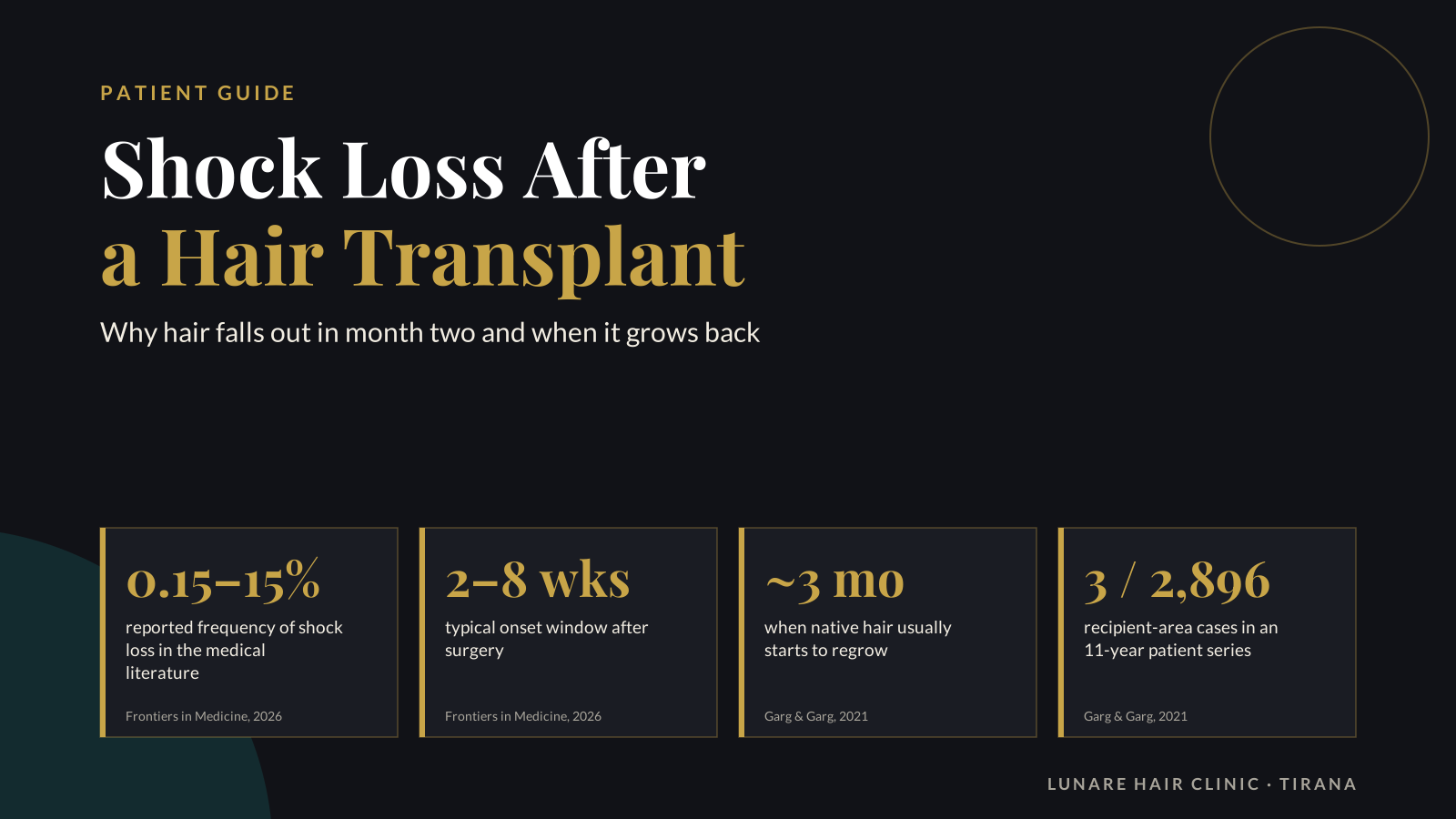
Key points
- In month two two things fall out: the transplanted hair shafts (expected in almost every patient) and, in some patients, native hair around or between the grafts (shock loss).
- Shock loss is a localised telogen effluvium. The follicle is not destroyed: it moves into a resting phase and restarts.
- It typically appears between week 2 and week 8, and native hair usually starts to regrow around month 3.
- Reported frequency in the medical literature ranges from 0.15% to 15%. Figures of 30–70% quoted online usually mix shock loss with normal graft shedding.
- Risk is higher in women, in patients with many miniaturised hairs in the recipient area and when grafts are packed very densely.
- Patchy thinning in the donor area that is still there at 12 months is not shock loss and needs a proper assessment.
Hair falling out in month two: two different things are happening
When patients say “my hair is falling out after the transplant”, they can mean two separate events. Clinic blogs and forums often call both of them shock loss. Doctors do not.
| Shedding of transplanted hair | Shock loss (native hair) | |
|---|---|---|
| What falls | The hair shafts of the grafts that were just implanted | Your own pre-existing hair, between and around the grafts, or in the donor area |
| Why | The graft is cut off from its blood supply during the transfer; the shaft is released while the follicle settles | Surgical stress pushes nearby follicles into the resting (telogen) phase ahead of time |
| When | Mostly weeks 2–4 | Mostly weeks 2–8; in rare high-density cases within days |
| How often | Almost every patient | A minority of patients; reported rates range from 0.15% to 15% |
| Does it grow back? | Yes: new growth usually starts around month 3–4 | Usually yes, typically within about 3 months; already weakened hairs may not |
The first process is so predictable that it is better described as a stage of the timeline than as a side effect. A review of hair transplant complications published in the Indian Journal of Plastic Surgery places the fall of implanted hair within three to four weeks and links it to the temporary interruption of blood supply during the transfer. What you lose is the shaft. The follicle, which is what you actually paid for, stays in place and starts a new cycle.
The second process, hair shock loss in the strict sense, is the subject of the rest of this article.
What shock loss is, and why surgery triggers it
Shock loss is a localised form of telogen effluvium. Normally around 85–90% of scalp hairs are in the growth phase at any time. A sudden stress can push a group of them into the resting phase all at once; a few weeks later, those hairs are released together. The American Academy of Dermatology lists undergoing an operation among the classic triggers of this kind of shedding, alongside high fever, childbirth and severe stress. It is the same mechanism behind the seasonal shedding we describe in our article on late-summer hair loss, only concentrated where the surgeon worked.
In a transplant, the local triggers are well described in the surgical literature:
- Micro-trauma from the incisions. Each slit or channel made to receive a graft passes close to existing follicles and can disturb them.
- Swelling and fluid. Post-operative oedema and an excessive volume of tumescent fluid increase the pressure around neighbouring follicles.
- Changes in local blood flow. Very dense placement of grafts can reduce oxygen supply to the surrounding tissue for a few days.
- General stressors. A fever in the days before surgery or significant psychological stress can add to the local effect.
The follicles most likely to react are the weak ones. In someone with androgenetic alopecia, the recipient area usually contains miniaturised hairs: thinner, shorter and closer to the end of their working life. Healthy, thick hairs tolerate the surgery much better. This is why shock loss is closely linked to the stage of hair loss described by the Norwood scale.
How common is hair transplant shock loss? Why the numbers do not match
Search for hair transplant shock loss and you will find figures such as “30 to 70% of patients”. The peer-reviewed data look very different:
- A 2026 review of complications after FUE in Frontiers in Medicine reports a frequency of recipient-area shock loss between 0.15% and 15%, and notes that the true incidence is not known because studies define and record it differently.
- In the series of 2,896 patients treated between 2009 and 2020 by the authors of the Indian Journal of Plastic Surgery review, only three cases of recipient-area effluvium were recorded, and one in the donor area.
- A Spanish single-centre study of 247 patients with androgenetic alopecia found 28 cases of an unusual, immediate linear shedding, all linked to very dense grafting of the temples (50–70 follicular units per cm²).
The gap has a simple explanation. When the normal shedding of transplanted hair is counted as shock loss, the figure inevitably climbs towards “most patients”. When only the loss of native hair is counted, it becomes a minority event, more frequent in specific profiles and with specific techniques.
Does shock loss always happen?
No. The shedding of transplanted hair happens in nearly everyone. Shock loss of native hair does not. A man with an advanced Norwood stage and almost no hair left in the recipient area has very little that could shed. A woman with diffuse thinning who receives grafts between existing hair is at the opposite end of the spectrum.
How long does shock loss last? The post-transplant timeline
Each patient has a slightly different schedule, but the published data and clinical experience converge on a fairly consistent sequence for post-transplant shock loss:
| Period | What usually happens |
|---|---|
| Days 1–10 | Small crusts around the grafts. In rare cases of very dense grafting, a thin line of native hair can be lost around the treated area within the first days. |
| Weeks 2–4 | The transplanted hair shafts fall out. Native hair may start to shed in the areas at risk. |
| Weeks 4–8 | Shock loss is at its most visible. Month two is often the thinnest point of the whole process. |
| Months 3–4 | Native hairs affected by shock loss typically come back; in the Spanish series, all the linear losses had regrown by the three-month visit. The first transplanted hairs appear, thin and soft. |
| Months 4–6 | Density builds up; shedding is no longer the main event. |
| Months 6–9 | In general telogen effluvium, the AAD indicates that hair usually returns to its normal fullness within six to nine months. |
| Months 12–18 | Final assessment of the transplant, later for the crown. |
So, how long does shock loss last? In most cases the shedding phase lasts a few weeks and regrowth of native hair begins around the third month. The Indian Journal of Plastic Surgery review places spontaneous regrowth at roughly three to four months. Full recovery of density can take longer, because regrown hairs start thin and need several months to reach their previous calibre.
One exception is worth stating clearly: hairs that were already severely miniaturised may not return. That is not damage caused by the surgery. It is the underlying hair loss continuing, made visible all at once.
Shock loss in the donor area
Shock loss in the donor area is less common than in the recipient area, but it worries patients more, because the back of the head was supposed to be the safe zone. It has been described in a Spanish series of 12 patients published in Dermatologic Surgery and in a four-case report in the Journal of Cutaneous and Aesthetic Surgery, where patches appeared two to three weeks after FUE and resembled alopecia areata on trichoscopy.
The appearance depends on the technique. After FUE, donor area shock loss shows up as diffuse or slightly patchy thinning near the extraction zone. After a strip (FUT) procedure, it tends to follow the line of the incision. The factors associated with it include accidental damage to blood vessels, excessive tension on the suture, smoking and diabetes.
Donor area shedding typically recovers. What does not recover is overharvesting: too many grafts taken from the same zone. The difference is time. Thinning that is still present and well defined at twelve months is not shock loss, and it should be measured rather than guessed at. We explain how that assessment works in our guide to a failed hair transplant and revision surgery.
Who is more at risk
The 2026 review in Frontiers in Medicine lists the risk factors most often associated with recipient-area shock loss. Combined with the other sources cited here, the profile is consistent:
- Women, and more generally patients with female pattern hair loss, because grafts are often placed among a lot of existing hair. Surgeons are advised to warn female patients about this possibility before surgery.
- Patients with many miniaturised hairs in the recipient area, typical of early or intermediate stages of androgenetic alopecia.
- High implantation density, especially in the temples and frontal area.
- Excessive tumescent fluid and local trauma during the procedure.
- Older age and significant psychological stress.
- A fever or acute illness shortly before surgery.
Density deserves a specific comment. Patients understandably want as many grafts as possible in the hairline. Packing them too tightly raises the risk of both shock loss and poor graft survival. The right density is a medical decision that depends on the donor area and on the native hair around the zone; we discuss the technical side in our comparison of FUE and DHI techniques.
Is it shock loss or something else? How to tell
Most shedding in the first three months is normal. A few patterns, however, deserve a check with your surgeon or a dermatologist:
| What you notice | Most likely | What to do |
|---|---|---|
| Transplanted hairs fall out in weeks 2–4, scalp otherwise calm | Normal graft shedding | Nothing. Wait for month 3–4. |
| Native hair thins between or around the grafts in weeks 2–8 | Shock loss | Take photos, follow your surgeon’s aftercare, wait at least three months before judging. |
| Diffuse or slightly patchy thinning in the donor area in the first weeks | Donor area shock loss | Report it to the clinic; it usually recovers within months. |
| Well-defined, sparse patches in the donor area still visible at 12 months | Overharvesting | Ask for a measured assessment of the donor area. |
| No new growth in the transplanted area at 8–12 months | Possible poor graft survival | Request a documented review with photos and graft counts. |
| Redness, pain, pus or swelling that gets worse instead of better | Possible infection or inflammation | Contact the clinic or a doctor promptly; do not wait for regrowth. |
The single most useful tool for telling these apart is photographic. The authors of the Spanish dense-grafting study recommend photographing both the treated and the untreated areas right after surgery, precisely because patients with shock loss feared that their grafts had failed. Take your own photos with the same light, distance and angle once a month: comparing month two with month four will tell you more than any forum thread.
Can post-transplant shock loss be prevented or shortened?
It cannot be eliminated completely, but the risk can be reduced. Responsibility is shared between the surgical team and the patient.
What depends on the surgical team
- Planning a density that respects the native hair already present, instead of maximising graft numbers.
- Using a gentle technique when opening channels or implanting grafts near existing hair.
- Avoiding excessive tumescent fluid.
- Explaining shock loss before surgery, not after it appears.
What depends on you
- Stabilise your native hair. A panel of 11 international hair restoration experts concluded, on the basis of clinical experience, that approved treatments such as minoxidil can speed up regrowth and protect weakened follicles in transplant patients. This is expert consensus rather than evidence from controlled trials, and any medication should be prescribed and timed by a doctor.
- Do not stop medical therapy on your own just before surgery. Ask your surgeon how to manage it around the procedure.
- Tell the clinic about fevers or illnesses in the days before surgery; postponing can be the right choice.
- Avoid smoking before and after surgery: it affects healing, including in the donor area.
- Follow the aftercare instructions for washing, sleeping position, sun and physical activity.
Supporting treatments
Some clinics, including ours, offer PRP and low-level laser therapy as part of the post-transplant care plan, with the aim of supporting the scalp during the healing phase. Evidence specific to shock loss is still limited, so these are options to discuss with the doctor case by case, not guarantees. The full list of what we offer is on our treatments page.
What shock loss forums get right, and what they get wrong
Many patients look for reassurance in shock loss forums, especially in month two. These threads can help, but they need to be read with some filters.
What they get right: they show that the month-two drop is common, that people who were scared at week eight were often satisfied at month twelve, and they push patients to document their progress with photos.
What they get wrong:
- Timelines are not transferable. One user’s regrowth at week ten does not mean yours is late at week twelve. Age, hair type, density and technique all change the schedule.
- Percentages are rarely sourced. Figures such as “70% of patients” usually come from clinic marketing and mix graft shedding with shock loss.
- Photos are not comparable. Wet hair, different lighting and different haircuts can make the same scalp look very different.
- Medical advice from strangers about starting or stopping medication should not replace your surgeon’s indications.
How we approach shock loss at Lunare Hair Clinic
Shock loss is easier to live with when it is expected. Before planning a transplant, our medical team assesses the native hair in the recipient area, the condition of the donor area and the stage of hair loss, and sets the density accordingly. The possibility of shock loss is discussed during the consultation, especially with female patients and patients in early stages of hair loss.
The first step is a free evaluation based on a few photos of your scalp. If you then decide to proceed, the package for international patients includes the flight and a two-night hotel stay in Tirana; our practical guide to Tirana explains how the trip is organised. If you are comparing offers from other destinations, our article on hair transplants in Turkey lists the questions to ask before paying a deposit.
Frequently asked questions
Does shock loss always happen after a hair transplant?
No. The shedding of transplanted hair shafts happens in almost every patient, but shock loss of native hair affects a minority. Reported rates in the medical literature range from 0.15% to 15%, with higher risk in women, in patients with many miniaturised hairs and with very dense grafting.
How long does shock loss last?
The shedding phase usually lasts a few weeks, mostly between week 2 and week 8 after surgery. Native hair typically starts to regrow around month three, although full density can take several more months because regrown hairs start thin.
Is shock loss permanent?
Usually not. The follicle moves into a resting phase and then restarts. Hairs that were already severely miniaturised by androgenetic alopecia may not return, but that reflects the underlying hair loss rather than damage from the transplant.
Can shock loss happen in the donor area?
Yes, although it is less common than in the recipient area. After FUE it appears as diffuse or slightly patchy thinning near the extraction zone, usually a few weeks after surgery, and it typically recovers. Thinning that persists at 12 months is more consistent with overharvesting.
Is it normal to lose hair two months after a hair transplant?
Yes. Month two often combines the shedding of transplanted hair with possible shock loss of native hair, which is why many patients look thinner than before surgery at this stage. New growth usually becomes visible from month three or four.
Can minoxidil reduce shock loss?
Expert consensus based on clinical experience suggests that approved treatments such as minoxidil can support weakened follicles and speed up regrowth after a transplant. Whether and when to use it must be decided by your doctor, because timing around surgery matters.
Is the shedding of transplanted hair the same as shock loss?
No. Transplanted hairs shed because the graft is temporarily cut off from its blood supply; this is expected. Shock loss is the temporary loss of your own pre-existing hair caused by the stress of surgery.

Shock Loss After a Hair Transplant: Why Hair Falls Out and How Long It Takes to Grow Back
Why hair falls out in month two after a transplant, how long shock loss lasts, donor area shedding, risk factors and the signs that it is not shock loss.

Hair Transplant in Turkey: Real Reviews, Risks and What Low-Cost Packages Hide
Planning a hair transplant in Turkey? Check the 8 questions every serious clinic answers in writing before you pay a deposit. Don’t book blind.

Androgenetic Alopecia and Norwood Scale: Stages, Symptoms and When to Intervene
How to recognise androgenetic alopecia, what each Norwood stage looks like and from which stage a hair transplant makes sense. Clear, sourced guide.
 English
  Italian