
Turkey is the world’s main hub for hair transplant tourism, and many of the procedures performed there are done well. So the useful question is not whether a hair transplant in Turkey is good or bad. It is how to tell a medical clinic from a sales operation when both show a 4.9 rating, a five-star hotel in the package and a price that is a third of what you were quoted in Italy. In this guide you will find how to read reviews, what the real risks are, what low-cost packages hide and the eight questions to ask before you pay a deposit.
A note on who writes this guide: Lunare Hair Clinic is in Tirana, Albania, so we compete with Turkish clinics. For that reason every figure below is linked to its source, and every criterion applies to us as much as to a clinic in Istanbul.
Key takeaways
- Turkey has excellent clinics and high-volume operations where technicians do most of the surgery. The price does not tell you which one you are booking.
- Reviews written a few days after surgery rate the hotel, the transfer and the staff. The result can only be judged after about 12 months.
- Under Turkish rules in force since 2023, only certified doctors may extract follicles and open the recipient channels, but one doctor can be responsible for up to five operating rooms.
- A flat price for “maximum grafts” rewards over-harvesting, and damage to the donor area cannot be undone.
- Before paying a deposit, get written answers on who operates, how many patients that doctor treats per day, what the price excludes and who follows you once you are home.
Hair Transplants in Turkey: Why Does Everyone Go There?
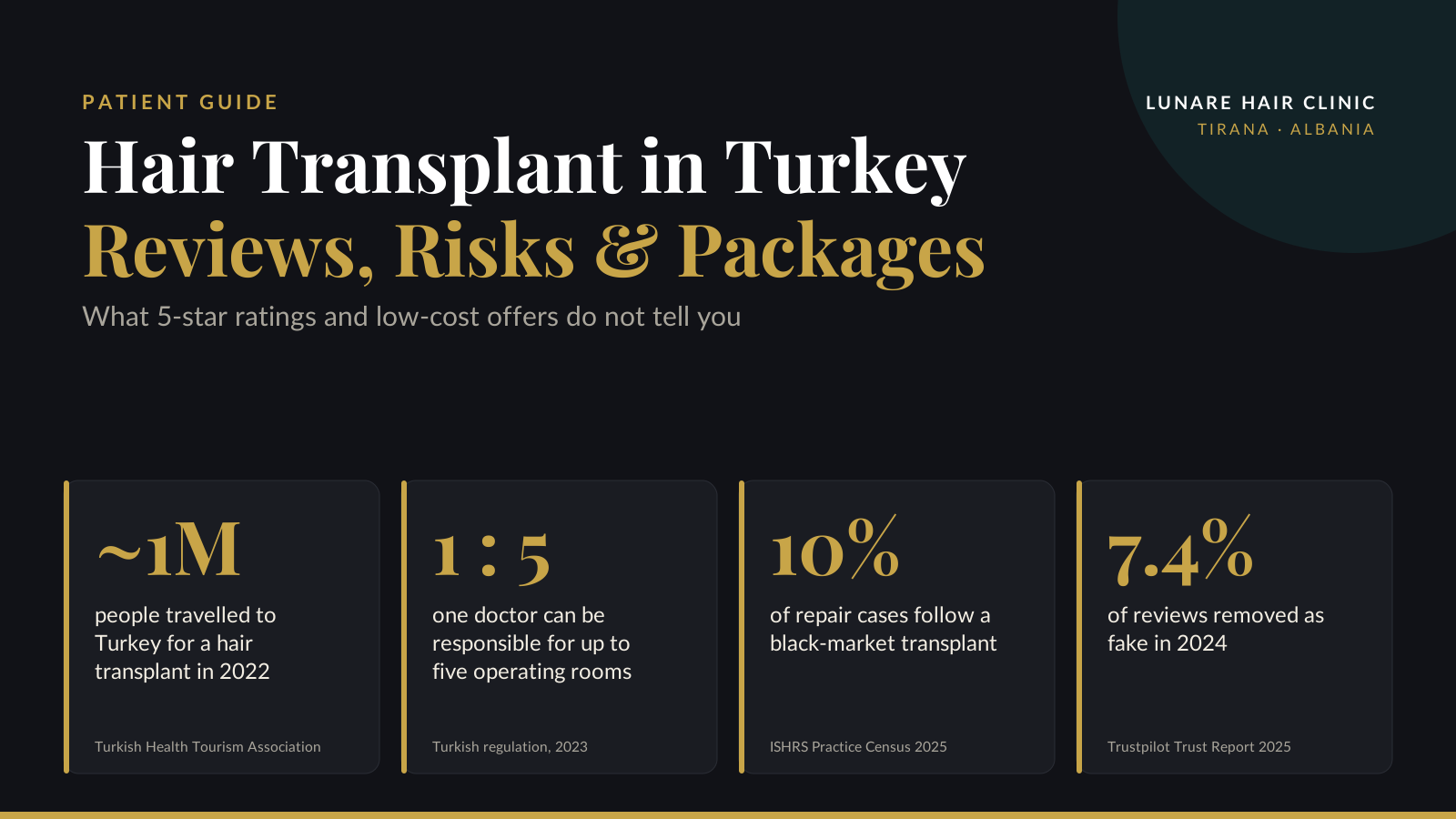
According to the Turkish Health Tourism Association, about one million people travelled to Turkey for a hair transplant in 2022, spending around 2 billion dollars (NPR, 2025). Estimates vary from source to source because there is no public registry of procedures, but the order of magnitude is not in dispute.
Three things explain it:
- Price: Italian media report €2,500–3,000 for a procedure in Turkey against €6,000–8,000 in Italy (Panorama, 2025).
- Packaging: surgery, hotel and transfers are sold as a single product and booked over a messaging app in a few days.
- Experience: clinics that perform thousands of procedures a year have built real skill, and a 2025 review in the journal Aesthetic Plastic Surgery acknowledges high graft survival in some centres.
The same review describes the other side of the model: a “permissive regulatory environment, lacking standardization, oversight, and consistent reporting”, a growing role for unsupervised technicians, bait-and-switch practices and what the authors call a “data black hole” on complications (Haider et al., 2025). Turkey is not one standard of care. It is a market with a very wide gap between its best and its worst clinics.
Hair Transplant in Turkey Reviews: What They Tell You and What They Cannot
Search for “hair transplant in Turkey reviews” and almost every clinic shows thousands of five-star ratings, on Google, on Trustpilot and on its own website. Most of them are real. The problem is what they measure: hair transplant in Turkey reviews are almost always written in the first days after surgery, when the result cannot be seen yet, and a small share of them are not genuine at all. Read with the right criteria, though, they remain a useful source, because they say a lot about how a clinic is organised and how it treats patients when something goes wrong. Here is how it works in practice, starting from what really happens in the days after the procedure.
1. Reviews of hair transplants in Turkey written on the third day: why aren’t they reliable?
Clinics usually ask for a review while the patient is still in Istanbul or has just returned home. At that point you can rate the airport pick-up, the interpreter, the room and how kind the staff were. You cannot rate the transplant: the transplanted hairs shed in the first weeks, regrowth starts after three to four months and the final result is visible at around 12 months. A clinic can therefore collect an excellent rating from patients whose outcome nobody has seen yet, the patients themselves included.
2. Fake Hair Transplant in Turkey Reviews: Not Every Review Is Genuine
Review platforms do filter. Trustpilot reports that it removed 4.5 million fake reviews in 2024, equal to 7.4% of all reviews submitted that year (Trustpilot Trust Report 2025). EU consumer law has prohibited fake and commissioned reviews since 2022, and requires traders to state whether and how they check that reviews come from real customers (Directive (EU) 2019/2161). Enforcing those rules against a company based outside the EU is much harder in practice.
3. Forums and “best hair transplant clinics in Turkey” rankings
Patient forums offer what reviews rarely do: photo diaries that follow the same person for a year or more. Read them with the same care, because clinic representatives and affiliates post there too, sometimes openly and sometimes not. Rankings of the best hair transplant clinics in Turkey deserve more caution still: many are published as sponsored content or press releases, so check the page for a “sponsored”, “partner content” or “press release” label before trusting the order. If you search for best hair transplant clinics in Turkey forum, use the results to collect long-term cases and questions to ask, not a shortlist to book from.
How to read Turkey hair transplant reviews in five minutes
Here are six tips to tell, in a few minutes, whether a clinic’s hair transplant in Turkey reviews describe real results or just a pleasant stay.
- Sort by date and look for bursts: dozens of five-star reviews in a few days, with similar wording, are a pattern worth noticing.
- Search for 12-month updates: one review that comes back after a year with photos is worth more than a hundred written at the hotel.
- Check the photos: same light, same angle, dry hair, and the donor area shown as well as the hairline. Wet, styled or filtered “after” photos hide density.
- Read the two- and three-star reviews first: they usually describe facts: who operated, how many grafts were counted, how the clinic answered when something went wrong.
- Look at how the clinic replies: a specific answer signed by a doctor is a good sign. A copied reply, or silence, is not.
- Look for names: reviews that name the coordinator and the hotel but never the doctor tell you who the patient actually met.
The real risks of a hair transplant in Turkey
A hair transplant is surgery under local anaesthesia. When it is planned and performed by a trained doctor in an authorised facility, serious complications are uncommon. The risks grow when a clinic’s economics depend on volume: many patients a day, as many grafts as possible per patient and as little doctor time as possible on each one.
The International Society of Hair Restoration Surgery (ISHRS) states that the pre-operative assessment, the surgical plan, hairline design, donor harvesting, the creation of recipient sites and the management of complications should be carried out by a licensed doctor (ISHRS). It warns about clinics where a doctor appears in the advertising but most or all of the surgery is delegated to technicians, with several patients operated on at the same time (ISHRS, black-market clinics).
Turkey regulated the sector in 2023. Under the Regulation on Hair Transplant Units, follicle extraction and the opening of the recipient channels are reserved for certified doctors, dermatologists and plastic surgeons, and the procedure must take place in a licensed unit inside a hospital, medical centre or polyclinic. Two details matter to you as a patient: the placement of the grafts can be delegated to certified assistant staff working under the doctor’s responsibility, and each doctor can be responsible for up to five operating rooms (Official Gazette of 6 May 2023, no. 32182).
This means that “performed by Dr X” can be perfectly legal and still describe a doctor who moves between five patients. It also means that the clinics the ISHRS calls black-market, with no licensed unit and no doctor at the chair, are operating outside Turkish rules, not within them. In both cases the question is the same: who does what, on me, and with how many other patients that day?
Failed Hair Transplant: How to Recognise It?
Most cases of a failed hair transplant fall into four groups:
- Over-harvested donor area: too many grafts taken, or taken from outside the safe zone, leave visible thinning and a patchy, “moth-eaten” look at the back of the head. The ISHRS describes this damage as irreversible. It also removes the reserve needed for any future correction.
- Unnatural hairline: a line drawn too low, too straight or too dense for the patient’s age looks artificial and uses up grafts that will be needed later, as hair loss progresses.
- Poor growth: grafts damaged during extraction, kept out of the body for too long or badly implanted do not survive. The patient finds out many months later.
- Infection and necrosis: rare, but serious. An ISHRS case report describes a 55-year-old man operated on in Turkey entirely by technicians who developed scalp necrosis three days after flying home. He needed more than 20 sessions of hyperbaric oxygen therapy and lost part of the grafts, and the clinic stopped answering once he reported the problem (ISHRS case study).
How often does this happen? Nobody knows precisely, and that is part of the problem. The best available indicator is the ISHRS 2025 Practice Census: 59% of member doctors report black-market clinics operating in their own cities (51% in 2021), and on average 10% of their repair cases follow a previous black-market transplant, up from 6% (ISHRS, 2025). These figures are worldwide, not specific to Turkey.
One point of fairness: complications happen in every country, Italy and Albania included. In July 2026 the president of the Italian Association of Aesthetic Plastic Surgery (AICPE) named Turkey and Albania among the main destinations for cosmetic tourism and gave the same advice for all of them: check the surgeon’s credentials, check the accreditation of the facility, make sure follow-up is available and do not choose on price alone (LaPresse, 2026). That is the standard we ask you to apply to us too.
For more information, you can also read: Guide to Failed Hair Transplants—What to Do?
What low-cost Turkey hair transplant packages hide?
A typical Turkey hair transplant package costs between €1,800 and €4,500, with entry offers below €1,500, as we detail in our 2026 price comparison. An analysis of advertised packages found prices from €1,450 to €3,000, with up to 6,000 grafts included at the same price (Wimpole Clinic, data from April 2025). The price is real. What matters is what it is built on.
| What the offer says | What to check |
|---|---|
| “All-inclusive from €1,500” | Flights are often not included. Ask about medication, blood tests, PRP and any supplement for the technique (DHI, sapphire blades) or for a senior doctor. |
| “Up to 6,000 grafts, one price” | A flat rate gives the clinic no reason to stop. The right number depends on your donor area, not on the price list. Ask for the planned number and the reason for it. |
| “Performed by Dr X” | Which steps does the doctor perform in person? How many patients are scheduled for that doctor on your day? |
| “5-star hotel and VIP transfer” | Hospitality is the cheap part of the package and says nothing about the surgery. Judge the operating room, not the lobby. |
| “Lifetime guarantee” | Is there a written threshold, such as a minimum growth rate at 12 months? Where is a correction performed, and who pays for flights and hotel? |
| “12 months of follow-up” | Who answers: a doctor or a sales coordinator? How quickly, and in which language? |
| “Offer valid until Friday” | Deadlines and deposits requested before a medical assessment are sales techniques, not medicine. |
What to Do If the Hair Transplant Clinic You Booked Isn’t the One Doing the Procedure?
The 2025 review in Aesthetic Plastic Surgery lists bait-and-switch among the documented practices of hair transplant tourism. It usually takes one of three forms: the doctor shown during the consultation is not the person who operates; the number of grafts or the technique agreed online changes on the day; an “upgrade” is proposed in the clinic, when you have already flown in and paid a deposit. The protection is the same in all three cases: a written treatment plan with names, graft range, technique and total price, received before you book the flight.
Turkish clinics with an Italian office: what changes and what does not
Several Turkish clinics advertise an Italian office or Italian-speaking consultants. It is a real convenience: you can talk to someone in your own language and sometimes have check-ups close to home. It does not change where the surgery takes place or who is responsible for it.
Before treating an Italian address as a guarantee, ask four things:
- Which company signs the contract, and which country’s law and courts apply if there is a dispute?
- Is the person you meet in Italy a doctor? If so, check the name in the national register of the Italian medical association (FNOMCeO).
- Are the check-ups in Italy carried out by a doctor, and are they included in the price?
- If a complication appears after you are home, who treats it, where and at whose cost?
Hair Transplant in Turkey: Eight Questions to Ask Before You Pay a Deposit
They apply in Istanbul, in Tirana and in Milan. A serious clinic answers all of them in writing.
- Who assesses my case and designs the hairline? Name and medical qualification.
- Who performs extraction, channel opening and implantation? Step by step, in writing.
- How many patients does that doctor treat on the same day?
- How many grafts do you plan, and why that number for my donor area?
- Is the facility authorised for hair transplants? In Turkey this means a licensed hair transplant unit inside a hospital, medical centre or polyclinic.
- What exactly is included in the price, and what is not?
- What does the guarantee say in numbers? And where, and at whose cost, is any correction performed?
- Who follows me for 12 months, and what happens if I have a complication at home?
The ISHRS publishes a longer checklist for patients: before you choose a surgeon.

Shock Loss After a Hair Transplant: Why Hair Falls Out and How Long It Takes to Grow Back
Why hair falls out in month two after a transplant, how long shock loss lasts, donor area shedding, risk factors and the signs that it is not shock loss.

Hair Transplant in Turkey: Real Reviews, Risks and What Low-Cost Packages Hide
Planning a hair transplant in Turkey? Check the 8 questions every serious clinic answers in writing before you pay a deposit. Don’t book blind.

Androgenetic Alopecia and Norwood Scale: Stages, Symptoms and When to Intervene
How to recognise androgenetic alopecia, what each Norwood stage looks like and from which stage a hair transplant makes sense. Clear, sourced guide.
 English
  Italian