How a Hair Transplant Works: FUE Technique vs DHI Technique
If you’ve started learning about hair transplants, you’ve already grappled with the question: FUE or DHI? And you’ve likely encountered two opposing narratives—DHI presented as an innovation that makes FUE obsolete, or FUE as the proven standard and DHI as a marketing premium.
Both are misleading. The clinical reality is simpler and more useful to understand: FUE and DHI are not two alternative procedures. They are two ways of managing the implantation phase of the same procedure.
With this clarification, the question “which is better” becomes the right one: which of the two is more suitable for my case, and why. This article will help you answer—or at least understand if the answer you’re given makes sense.
FUE or DHI: The Short Answer
Neither technique is objectively better: FUE and DHI both address the same stage of the transplant – namely, the implantation – but using different approaches.
Overall, FUE is the most efficient choice for large areas where a large number of follicular units are required in a single session. DHI is the most precise choice for the frontal hairline and for increasing the density of existing hair, where control over angle and density is more important than speed. In many cases, the best solution is a hybrid approach that uses both techniques in different parts of the same area. The rest of this article explains why.
How a hair transplant works: the two key stages
Regardless of the acronym on the quote, a modern hair transplant consists of two distinct phases.
- Extraction: follicular units—small groups of one to four hairs—are harvested one by one from the donor area, usually the back and sides of the head, where hair is genetically resistant to loss. Harvesting is done with a micropunch, a hollow instrument less than a millimeter in diameter, under local anesthesia.
- Implantation: the harvested units are inserted into the area to be thickened, respecting the angle, direction, and density of the existing hair for a natural-looking result.
Here’s the point that almost no headline clarifies: the difference between FUE and DHI almost always concerns only the second phase. In many clinics’ practice, extraction is the same. This is why several medical sources point out that a procedure labeled “DHI” still involves an FUE harvest followed by an implant with a dedicated instrument.
How the FUE Hair Transplant Technique Works
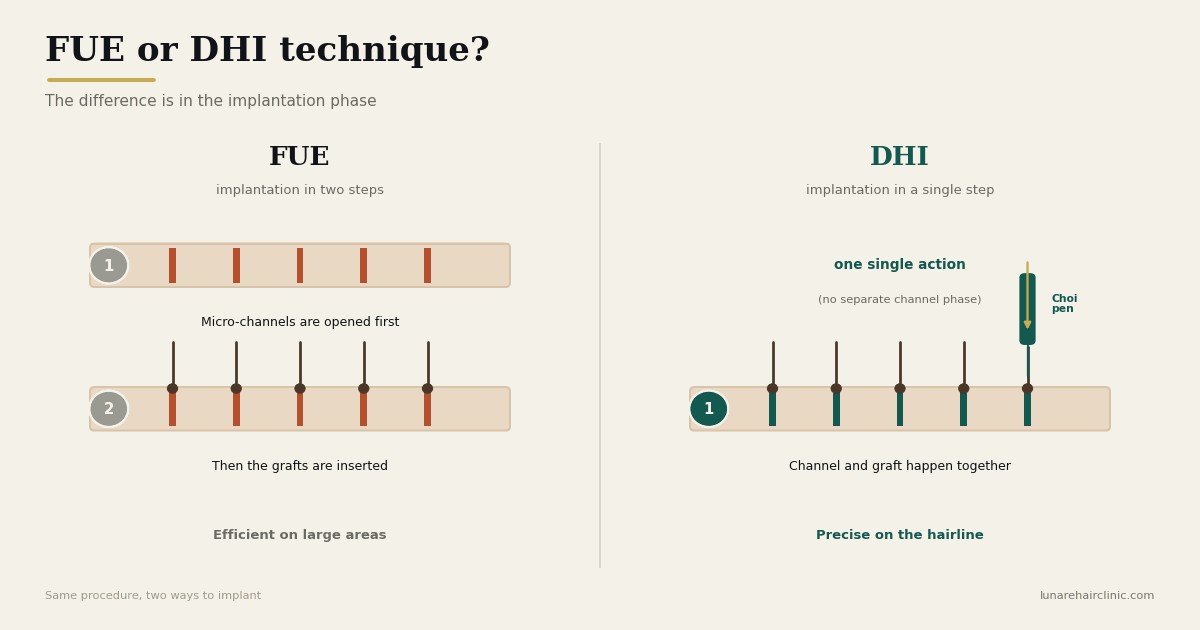
In FUE (Follicular Unit Extraction) the implantation occurs in two separate steps.
First the surgeon creates micro-channels in the recipient area: small incisions that define in advance where, at what angle and with what density the hair will go. Then the follicular units, preserved in a protective solution after collection, are manually inserted into the already opened channels.
Separating the two moments has a concrete advantage: the surgeon designs the entire architecture of the recipient area before starting to implant, and can work efficiently on large surfaces. For this reason, FUE is generally indicated when the area to be covered is large and many units are needed in a single session.
There is an inaccuracy circulating about FUE that needs to be corrected: it is often read that it would be “scarless”. It’s not like that. FUE does not leave the linear scar of the old strip technique (FUT), but leaves punctate micro-scars in the donor area, normally invisible with short hair but still present. Anyone who describes her to you as “scarless” is simplifying incorrectly.
The sapphire variant
When you hear “sapphire FUE,” you’re referring to a variant in which the microchannels are opened with sapphire blades instead of steel. The theoretical advantage is a cleaner incision and potentially faster healing. It’s a refinement of the channel-opening process, not a separate technique: it’s still an FUE.
How the DHI Hair Transplant Technique Works
In DHI (Direct Hair Implantation), the two implantation steps occur simultaneously, thanks to a tool called the Choi pen (Choi Implanter Pen).
The pen has a thin, hollow tip that loads the individual follicular unit. Upon insertion, the tip creates the micro-site and simultaneously deposits the follicle. There is no separate channel-opening phase: site creation and implantation are a single action.
The advantage attributed to this approach in the literature is finer control over the angle, direction, and depth of each individual graft, and a shorter interval between extraction and implantation. For this reason, DHI is particularly indicated for areas where precision is most important—particularly the frontal hairline—and when increasing density among existing hair without damaging it, because it does not require opening channels between existing follicles.
However, it has recognized practical limitations: it generally allows for a smaller number of grafts per session, requires a highly trained team to use the pen and rapid, continuous loading of grafts, and involves longer operating times. These factors—not a marketing premium—explain why DHI typically costs more than FUE.
FUE or DHI: Comparing the Two Hair Transplant Techniques
| FUE | DHI | |
|---|---|---|
| Affected phase | two-step system | one-step installation |
| Opening of the channels | separate, before implantation | contemporary with the implant (Choi pen) |
| Angle and density control | high, planned in advance | very fine, graft by graft |
| Grafts per session | suitable for high numbers | generally lower |
| Typical indication | large areas, many units | hairline, density in delicate areas |
| Cost | more content | generally superior |
| Recovery and visible results | full at 12–18 months | full at 12–18 months |
Indications: the choice between the two techniques depends on the clinical evaluation of the individual case.
Note the last line: recovery times and final results are comparable. The choice between the two doesn’t change whether it works, but where and how it performs better.
Which technique for which case
FUE tends to be preferred when:
- the area to be treated is large, and many follicular units are needed in a single session;
- the primary objective is to efficiently cover extensive thinning areas (crown, vertex);
- the aim is to optimize the ratio between the number of grafts and cost.
DHI tends to be preferred when:
- the work is done on the front hairline, where the angle and naturalness are crucial;
- the aim is to add density to existing hair, without risking damage;
- the area is limited but requires maximum aesthetic precision.
And often the best answer is both. Many clinics adopt a hybrid approach—DHI on the hairline, where precision matters, and FUE on larger areas, where efficiency matters. It’s not a compromise: it’s using each tool where it works best.
This is precisely the sign of a good consultant: they don’t sell you “their technique,” but explain why they offer a choice based on your donor area, the area to be covered, and the aesthetic result you’re seeking. If someone presents one of the two as always and in any case superior, they’re telling you their price list, not your clinical indication.
The three questions that reveal a serious clinic
- Why do you recommend this technique in my specific case? The answer should address your donor and recipient areas, not the general qualities of the method.
- Who actually performs the extraction and implantation? The accuracy of DHI depends entirely on the hand holding the pen. It’s worth knowing if it’s the doctor’s hand.
- How many grafts do you estimate, and on what basis? A number given before assessing the donor area’s density is a marketing number.
Frequently Asked Questions
- How does a hair transplant work, in short?
Follicular units are harvested from the donor area, which is resistant to hair loss, and implanted in the thinning area, respecting the natural angle and direction. The entire session is typically performed in a single day, under local anesthesia, and lasts from four to eight hours depending on the number of grafts.
- FUE or DHI: Which Should You Choose?
Neither is “better” overall. FUE is better for large areas, while DHI is better for the precision of the frontal line and thickening existing hair. Many procedures combine the two. The choice depends on the individual case, not on a fixed hierarchy.
- Does the FUE technique leave scars?
It doesn’t leave the linear scar of the FUT technique, but it does leave pinpoint micro-scars in the donor area, which are generally invisible with short hair. Calling it “scarless” is inaccurate.
- Does DHI hurt more than FUE?
Both are performed under local anesthesia, and the level of discomfort is comparable. Recovery is similar for both techniques.
- What is sapphire FUE?
It’s a type of FUE in which the microchannels are opened with sapphire blades instead of steel, for a cleaner incision. It’s a variant of the opening phase, not a separate technique.
- When are results visible?
For both techniques, the results are fully visible between 12 and 18 months after the procedure, after the normal hair loss and regrowth phase.
In summary
FUE and DHI aren’t two crossroads to blindly choose between. They are two tools that act on the same phase—the implant—with different logics: FUE excels in efficiency on large surfaces, DHI in precision on details. The final result, in expert hands, converges.
The useful question, therefore, is not “FUE or DHI?”, but “What is the right indication for my donor area and the area I want to thicken?” That question is answered with an assessment, not with a brochure.
Medically reviewed by Dr Aldo Alessi, Lunare Hair Clinic. Last updated 31/07/2026.
Your new hair begins with a free conversation.
Table of Contents

Androgenetic Alopecia and Norwood Scale: Stages, Symptoms and When to Intervene
How to recognise androgenetic alopecia, what each Norwood stage looks like and from which stage a hair transplant makes sense. Clear, sourced guide.

Hair Transplant in Tirana: A Practical Guide to Flights, Accommodation and How Many Days You Need
Once you have decided that a hair transplant abroad makes sense, medical doubts are usually cleared up quickly. It is the practical ones that hold
Hair Transplant Before & After: Month by Month
What a hair transplant really looks like month by month: shedding, shock loss, regrowth at 3-6 months and the final result at 12-18. With photo protocol.
FAQ
Am I a good candidate for a hair transplant?
Most patients with stable hair loss and a sufficient donor area are good candidates. During the online evaluation, our doctors will analyze your photos and medical history to confirm whether a transplant is recommended and which technique fits best.
Is the hair transplant painful?
he procedure is performed under local anesthesia. You may feel mild discomfort when the anesthesia is injected, but the surgery itself is usually well tolerated. After the procedure, you may experience slight tension or sensitivity, which is managed with medication.
How long does the procedure take?
Depending on the number of grafts, a hair transplant typically takes between 4 and 8 hours, including breaks and preparation
When can I go back to work?
Many patients return to desk work after 3–5 days. If your job is physically demanding or involves sun exposure, you may need a longer break. Our team will give you tailored advice.
What do you mean by “guaranteed results”?
By “guaranteed results” we mean that we stand behind our work with:
- clear, realistic expectations before the surgery
- a written aftercare plan
- structured follow-up to monitor your progress
In specific cases, if results are significantly below expectations despite correct aftercare, our medical team may propose additional corrective sessions or solutions.
Is Albania safe for medical tourism?
Yes. Albania has become an increasingly popular destination for medical tourism thanks to modern clinics, qualified doctors and competitive prices. At Lunare Hair Clinic we work with strict hygiene standards and offer full logistical support for your stay.
What’s the difference between FUE, FUT and DHI?
FUT (Strip method)
A strip of skin is removed from the donor area, then divided into follicular units.
Leaves a linear scar on the back of the head.
Usually allows a large number of grafts in a single session.
FUE (Follicular Unit Extraction)
Individual follicles are extracted one by one using a micro-punch.
No linear scar, only tiny dot scars, usually invisible with short haircuts.
Faster recovery and less post-op discomfort compared to FUT.
DHI (Direct Hair Implantation)
Uses FUE to extract grafts, but implantation is done with special implanter pens.
Allows very precise control of angle, direction and depth of each hair.
Particularly suitable for hairline design and detail work.
You can think of DHI as an “evolved” way of implanting FUE grafts, not a completely separate transplant method.
When will I see results?
Hair transplant results follow a clear timeline:
0–2 weeks: healing and formation of scabs
1–3 months: temporary shedding of transplanted hairs (normal process)
3–6 months: first new hairs start growing
6–9 months: visible improvement in density
9–12 months: final result in most patients
So you need patience: it’s a long-term investment, not an instant makeover.
Are the results permanent?
Transplanted hair is taken from areas genetically more resistant to baldness, so it usually keeps growing for life.
However, non-transplanted hair can continue to thin over time. That’s why stabilizing hair loss (with medical therapy when indicated) and planning a long-term strategy with your doctor is important.
What are the main risks or possible complications?
When performed by experienced doctors in a proper medical setting, hair transplant is generally safe, but as with any medical procedure there are potential risks:
Swelling and bruising
Temporary numbness or sensitivity
Infection (rare with correct hygiene)
Folliculitis (inflammation of follicles)
Suboptimal growth or density if aftercare instructions are not followed or if grafts are not handled correctly
A serious clinic will explain risks clearly and give you written post-op instructions.
 English
  Italian