Every week, clinics across Europe see the same patient with a failed hair transplant: eighteen months after an all-inclusive package, the hairline sits too low and too straight, the crown never filled in, and the back of the head shows pale patches under short hair. The money is gone, and the donor area, the one truly limited resource in a hair transplant, has been poorly spent.
The good news is that a substantial share of these results can be improved. The uncomfortable news is that repair work is harder, slower and more expensive than a well-planned first procedure, and not every case can be fully corrected. Here’s what actually separates a transplant that’s still growing in from one that’s genuinely failed, the seven-point audit surgeons use to measure the damage, what revision surgery can and can’t fix, and the questions worth asking before you book a repair.
Failed Hair Transplant or Is It Still Too Early?: What to Check
Most patients who come in for a consultation claiming to have undergone a “failed hair transplant” are those who are judging the results too soon. Grafts do not grow in a linear fashion. Let’s take a look at the steps involved in a hair transplant and the main stages.
| Timeline | What is normal |
|---|
| Weeks 2–4 | Transplanted hairs shed. The follicle stays; the shaft falls out. This is expected, not failure. |
| Months 1–3 | Shock loss. Surrounding native hairs — and hairs around the donor extraction sites — can go dormant and shed after surgical trauma. In most cases they recover. |
| Months 4–6 | First visible regrowth, thin and uneven. Density looks patchy by design. |
| Months 7–12 | Progressive thickening. Hair shafts gain calibre and the result starts to look coherent. |
| Months 12–18 | Final assessment window. Crown results in particular can take up to 18 months. |
Do not evaluate a hair transplant before month 12. Judging at month 6 and booking a corrective procedure out of panic is the single most common way patients turn a mediocre result into a permanent one.
There is one exception. A small number of signs are surgical complications, not slow growth, and need medical attention within days rather than months: spreading redness and pain, purulent discharge, fever, or dark, dusky skin in the recipient area that may indicate necrosis. If any of these appear in the first weeks, the patient should see a doctor immediately — ideally the operating surgeon, and if that is not possible, a dermatologist locally.
Failed Hair Transplant: The Six Most Common Patterns
Once the 12-month mark has passed, poor results fall into recognisable categories. Most damaged patients present with two or three at once.
1. Hairline design errors
The most visible failure, and the hardest to hide. Hairlines placed too low on the forehead, drawn as a straight line rather than an irregular soft transition, or shaped without accounting for future hair loss. A 26-year-old given an aggressive teenage hairline will look progressively stranger as the surrounding native hair recedes behind it.
2. Wrong angle and direction
Hair exits the scalp at an acute angle that varies by zone. Grafts implanted too vertically, or pointing in the wrong direction, produce hair that will never lie flat — the “doll hair” or brush effect that is obvious in daylight regardless of density.
3. Low density and poor graft survival
Either too few grafts were placed for the area covered, or the grafts placed did not survive. Graft survival depends on how long follicles spend outside the body, how they are stored, how they are handled and how the incision sites are made. Handling errors are invisible to the patient on the day and only surface a year later as thin, see-through coverage.
4. Oversized or “pluggy” grafts
Grafts containing too many hairs placed in the frontal hairline create visible tufts. Modern follicular unit work should place single-hair units at the leading edge and build density behind it.
5. Donor area damage
The most consequential category, because it limits everything that can be done afterwards. Two forms:
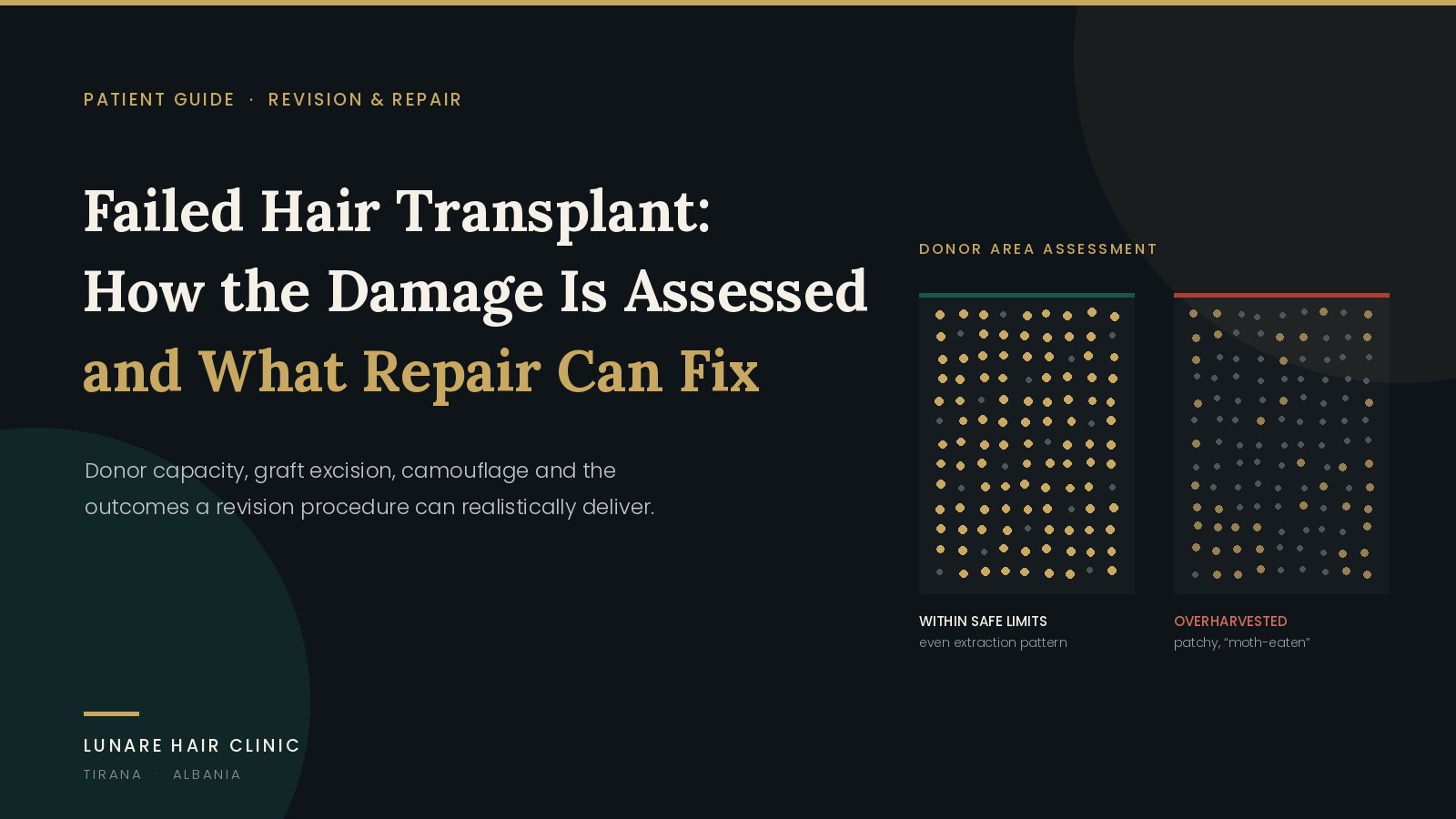
- Overharvesting: taking too high a percentage of follicles from a zone leaves the classic “moth-eaten” look — visible thinning, patchiness and pale dot scarring under short hair. Some clinics also harvest above the safe permanent zone, so those transplanted hairs are themselves destined to fall out later.
- Scarring: with FUT, a scar placed too high, or one that widens over time. With FUE, dot scarring that becomes visible when punches are too large or extraction sites too close together.
The International Society of Hair Restoration Surgery reports that repair cases traced to black-market and unlicensed clinics rose to roughly 10% of member repair cases in 2024, up from about 6% in 2021, with overharvested donor areas among the leading complications.
6. Post-surgical complications
Folliculitis, epidermal cysts, prolonged numbness, hypertrophic scarring and, in rare cases, necrosis of the recipient-area skin caused by incisions made too densely or too deep. Necrosis leaves an area that’s both bald and scarred, and it’s one of the hardest presentations to repair.
Assessing Hair Transplant Damage: The Surgeon’s Seven-Point Audit
A serious repair consultation is not a five-minute photo review over WhatsApp. It is a measurement exercise, because the entire repair plan depends on one number: how much usable donor hair is left.
1. Documentation audit: what technique was used, how many grafts were quoted versus documented, who physically performed the extraction and implantation, and what the immediate post-operative photos show. Patients who cannot obtain an operative record from the original clinic should say so — the absence of documentation is itself diagnostic information.
2. Recipient area mapping: density measured in follicular units per cm², hairline position relative to facial proportions, graft size distribution, and the angle and direction of implanted hairs, assessed under magnification.
3. Donor capacity calculation: this is the core of the assessment. Native donor density is typically in the range of 60–100 follicular units per cm². Responsible surgical practice keeps total lifetime extraction within roughly 40–50% of available follicles in any given zone, and commonly cited estimates put maximum lifetime harvest for most patients around 4,000–8,000 grafts. The surgeon measures what remains, zone by zone, against what has already been taken.
4. Scar mapping: location, width, colour and texture of FUT scars; density, size and distribution of FUE punch scars; skin quality and vascularity in scarred zones, which determines whether new grafts can survive there.
5. Scalp assessment: laxity, thickness, signs of active inflammatory scalp disease, and the presence of any condition that would compromise healing.
6. Progression staging: current Norwood stage, family history, rate of loss over the past three years, and whether the patient is on finasteride or minoxidil. Repairing a result while the underlying loss continues unchecked simply schedules the next disappointment.
7. Goal calibration: the surgeon states plainly what the available donor supply can buy. If the patient’s target requires 4,000 grafts and 1,800 remain, that conversation happens before anything is booked, not after.
What to bring to a repair consultation after a Failed Hair Transplant
- Photos taken before the original procedure
- Immediate post-operative photos, especially of the donor area
- The operative report, invoice or package documentation, if available
- Current photos in natural light: front, both sides, crown, donor area, wet and dry
- A written list of every medication and treatment used since surgery
Considering a second opinion? Lunare Hair Clinic reviews repair cases and gives a written donor-capacity assessment before any procedure is proposed.
Hair Transplant Revision Surgery: What It Can and Can’t Fix
Repair work is a distinct discipline within hair restoration. It uses the same instruments as a primary transplant with an almost opposite logic: the primary goal is often subtraction before addition.
1. Removing or relocating misplaced grafts
FUE punches can selectively excise individual grafts that sit too low, at the wrong angle, or in visible tufts. Where the follicles are healthy, extracted grafts can be re-implanted in a more appropriate area — effectively recycling donor hair that was previously wasted. This is the most powerful tool in repair work, and it is why FUE transformed the correction of old “pluggy” results.
2. Camouflaging with new grafts
Fine single-hair grafts placed in front of and between existing coarse or badly angled grafts soften the transition and break up an artificial line. Camouflage is frequently combined with partial excision rather than used alone.
3. Rebuilding the donor area
Overharvested zones can sometimes be improved by transplanting grafts into the donor area itself, drawn from less depleted regions or from beard hair. FUT scars can be revised surgically, or grafted into. Neither approach restores the original appearance; both aim to make the area presentable at a normal hair length.
4. Expanding the donor pool
When scalp donor supply is exhausted, beard and body hair (chest, abdomen) can be harvested with FUE. Beard hair is coarse and grows differently from scalp hair, so it is used strategically — for density behind the hairline, for scar camouflage, for the crown — rather than at the leading edge.
5. Scalp micropigmentation
SMP uses fine tattoo pigment to create the visual impression of density. It does not grow hair, but it reduces contrast between scalp and hair, and it is genuinely effective for camouflaging donor dot scarring, FUT scars and low-density zones. It works with surgery, not instead of it, in most repair plans — and its results depend heavily on the practitioner’s experience with hair-loss patients specifically.
6. The Limitations of a Hair Transplant Revision Procedure
| Problem | Realistic outcome |
|---|
| Hairline too low or too straight | Usually correctable, often over 2+ sessions |
| Wrong angle / pluggy grafts | Usually correctable via excision + re-implantation |
| Low density with donor left | Correctable — this is standard second-session work |
| Low density with donor exhausted | Partial improvement only; SMP and hairstyle strategy become central |
| Moth-eaten donor area | Improvable, rarely fully restored |
| Wide FUT scar | Improvable via revision, grafting or SMP; a fine line usually remains |
| Necrosis / significant scar tissue | Limited — poor blood supply reduces graft survival in scarred skin |
| Grafts placed outside the safe donor zone | Those hairs will still be lost over time; planning must assume it |
A surgeon who guarantees full correction of a badly overharvested donor area is repeating exactly the sales behaviour that caused the problem.
Hair Transplant Repair Cost, Timing and Sessions
Wait at least 12 months after the original procedure before any repair, and longer if the scalp is still inflamed. Operating on a scalp that has not finished healing risks compounding the scarring.
Complex repairs commonly require two or three procedures, spaced 8–12 months apart to allow full growth and healing between stages. Excision is often done first, with re-grafting in a later stage.
Expect a higher cost per graft than a primary procedure. Repair work is slower, more technically demanding, and typically involves fewer grafts placed with far more planning. Any clinic pricing a repair the same way it prices a routine 3,000-graft package has probably not assessed the case properly. For context on standard pricing across markets, see our breakdown of what a hair transplant actually costs in Italy, Turkey and Albania.
Corrective hair transplant without shaving: Is it possible?
This is one of the most common questions, and the honest answer is: partially.
Unshaven and partially shaved techniques exist and work well for small, targeted interventions — refining a limited section of hairline, excising a modest number of misplaced grafts, or adding a few hundred camouflage grafts. In those cases only the donor extraction strip needs trimming, and it can usually be hidden under longer hair above it.
For larger repairs, shaving is not a preference but a technical requirement. Precise extraction from a partially depleted donor area, and dense implantation between existing grafts, both demand full visibility of hair angle and exit point. Working blind on a compromised scalp is how donor areas get damaged twice.
A clinic that promises a large unshaven repair without examining the donor area is selling convenience, not surgery.
Why Low-Cost Hair Transplant Clinics Produce So Many Repair Cases
The pattern behind most repair consultations is structural rather than national. It appears wherever a high-volume, low-price model has developed faster than its regulation:
- Surgery delegated to technicians: in many high-volume centres the physician appears briefly for consultation and marking, while extraction and implantation are performed by non-medical staff — sometimes on several patients simultaneously.
- Graft counts that are quoted, not documented: a package sold as “5,000 grafts” with no operative record and no post-operative donor photos cannot be verified by the patient, ever.
- Donor area treated as unlimited: aggressive harvesting produces impressive day-one graft counts and a permanently damaged donor zone.
- No follow-up: the patient flies home on day three. When problems emerge at month eight, the coordinator has stopped replying.
None of this is a statement about a country. It is a statement about a business model, and it exists in Turkey, in Albania, and in Western Europe. What differs between clinics is whether a licensed surgeon performs the surgery, whether the graft count is documented, and whether anyone answers the phone a year later. We compare how the two main European destinations handle exactly these points in our guide to hair transplants in Albania versus Turkey.
Hair Transplant Revision Checklist: How to Avoid a Second Failure
If you are choosing a clinic for repair work, the stakes are higher than they were the first time — there is less donor hair to spend and less margin for error. Ask, in writing:
- Which named, licensed surgeon will perform my procedure, and what are their credentials?
- How many repair cases do you handle per year, and can I see before-and-after photos of comparable cases?
- Will the surgeon personally perform extraction and implantation, or supervise technicians?
- What is my measured remaining donor capacity, in grafts?
- Will you excise existing grafts, add new ones, or both — and in what sequence?
- How many sessions will this take, and over what timeframe?
- Will I receive a written operative report with the final graft count?
- What are the photos of the donor area going to look like immediately after surgery?
- What outcome are you not promising?
- What is the follow-up protocol at 3, 6 and 12 months, and who conducts it?
A clinic that answers question 9 without hesitation is the one worth talking to. For an overview of the techniques and how they differ, see our explanation of FUE and DHI, and our full list of treatments.
Frequently asked questions
How do I know if my hair transplant failed or is just growing slowly?
Assess at 12 months, and at 18 months for the crown. Before that, thin and uneven coverage is expected. Signs that do not resolve with time — a hairline drawn in the wrong position, grafts pointing the wrong way, visible patchiness in the donor area — are design and technique problems, not timing problems.
Is shock loss in the donor area permanent?
Usually not. Shedding around extraction sites in the first months typically recovers as follicles resume their cycle. Persistent thinning at 12 months is more likely to reflect overharvesting than shock loss, and requires measurement of donor density to distinguish the two.
Can every failed transplant be repaired?
No. The limiting factor is remaining donor hair. When the donor area has been heavily overharvested, or when scarring has compromised the blood supply of the recipient area, improvement may be partial and SMP or non-surgical camouflage may deliver more than further surgery.
How long should I wait before a repair procedure?
At least 12 months from the original surgery, and longer if healing is incomplete. Earlier intervention risks worsening the scarring and consuming donor hair that a better plan would have used more efficiently.
Does a repair cost more than a normal hair transplant?
Generally yes, per graft. Repairs involve excision, careful staging and lower graft volumes with higher technical demands.
Are the side effects of a revision procedure different from a first transplant?
The risks are the same in kind — swelling, temporary numbness, folliculitis, shock loss — but higher in a scarred or depleted scalp, which is precisely why case selection and surgical experience matter more in repair work.
Sources and further reading
Get an honest assessment of your case
If you are living with a result you are not happy with, the first step is not another procedure — it is a proper measurement of what you have left to work with.
Lunare Hair Clinic reviews international repair cases and provides a written assessment of donor capacity and realistic outcomes before recommending anything. Travel, airport transfers and two nights of accommodation are included in our packages for international patients.
This article is for information only and does not replace an in-person medical consultation. Individual results depend on scalp condition, donor supply and the stage of hair loss.
Medically reviewed by Dr Aldo Alessi, Lunare Hair Clinic. Last updated 28/08/2026.





 English
  Italian