

Hair Transplants in Italy: How Much Do They Really Cost, and Why Do People Choose Clinics Abroad?
How much does a hair transplant cost in Italy? In 2026, a hair transplant performed in Italy generally costs between 3,000 and 10,000 euros, depending mainly on the number of follicular units required. If the surgeon does not certify that the procedure is for therapeutic purposes, 22% VAT must be added. The same procedure abroad—in Turkey or Albania—usually costs between 1,500 and 3,500 euros, including flights and accommodations. Below is a comprehensive analysis of the reasons behind this price difference and the situations in which it’s worth incurring this expense.
In this article, we’ll take a closer look at the cost of a hair transplant in Italy and why more and more patients are choosing to go to clinics abroad, such as our clinic specializing in transplants in Albania.
What a hair transplant costs in Italy in 2026
Italian clinics price almost exclusively by the number of follicular units. Here are the current hair transplant prices advertised on the Italian market:
| Case size | Typical grafts | Advertised price range in Italy | Derived cost per graft |
|---|---|---|---|
| Localised — hairline or crown only | up to 2,000 | €3,000 – €5,000 | ~€1.50 – €2.50 |
| Multiple zones — the most common case | 2,000 – 4,000 | €5,000 – €8,000 | ~€1.70 – €2.70 |
| Extensive — advanced Norwood stages | 4,000+ | €8,000 – €10,000+ | ~€2.00 – €2.50 |
Sources: published 2026 price ranges from Italian clinics (Tricomedit, Masullo Medical Group, Medicina Estetica Migliorini) and international aggregator data putting the Italian average around €5,500–€6,000 (Bookimed). Per-graft figures are derived from bracket midpoints, not quoted directly by the clinics.
Two things about this table matter more than the numbers themselves.
First, the ranges overlap heavily. A 2,500-graft case can be quoted at €4,200 by one clinic and €7,900 by another in the same city. That spread is not explained by graft count — it is explained by who operates, how long the session runs, and what is bundled into the fee.
Second, almost none of these figures include VAT in the way you would expect.
Hair Transplant in Italy: The Five Things That Really Drive the Price
A hair transplant quote in Italy is never a single number — it’s the sum of several variables that interact with each other, and most patients only ever see the final total. These are the five factors that actually determine what you’ll pay, and why two quotes for the same case can differ by thousands of euros.
1. Surgeon’s Time: Why You’re Paying for Expertise, Not Just Grafts
A 3,000-graft session runs six to eight hours and occupies an operating room, a surgeon and two to four assistants for a full working day (surgeon staff). In Italy, that block of clinical time is the single largest cost line. Graft count is a proxy for it, not the cost itself — which is why quotes stop scaling linearly above roughly 3,500 grafts.
2. The 22% VAT most patients never see coming
This is the least understood item in any Italian quote, and it is worth understanding properly.
Since December 2023, Italian law (art. 4-ter of D.L. 145/2023, converted into L. 191/2023) has removed the automatic VAT exemption for aesthetic surgery. The exemption now applies only when the therapeutic purpose of the procedure is documented in a prior written medical attestation. Without that attestation, the invoice carries 22% VAT.
In June 2025, the Italian Revenue Agency (Risoluzione 42/E) clarified that the attestation may be issued by the operating surgeon and that the therapeutic threshold is not to be read restrictively — it includes protecting or restoring psychophysical health.
What this means in practice:
Â
-
- A €7,000 procedure becomes €8,540 if no attestation is issued.
-
- Whether your case qualifies is a clinical judgement your surgeon makes and documents before the operation, not something you can request afterwards.
-
- Ask, in writing, whether the quote is VAT-inclusive. Many Italian price lists are published net of VAT.
3. Facility and Overheads: Why Structural Costs Add Up
Italian clinical overhead, staff contracts, facility authorisation, professional liability insurance, energy, is among the highest in Europe. This is a real cost of a regulated system, not padding, and it is one reason an Italian quote cannot compete with a Balkan one on price alone.
4. Pricing models that penalise larger cases
Where clinics charge strictly per graft, a Norwood V patient needing 4,500 units pays roughly twice a Norwood III patient — even though the surgical day is the same length. Fixed-package pricing, more common outside Italy, flattens that curve.
5. What sits outside the quote
Pre-operative blood work, the first medicated wash, take-home medication, PRP sessions, and follow-up visits at months 3, 6 and 12 are frequently invoiced separately in Italy. Across a 12-month course, these add a realistic €300–€900.
Is a hair transplant tax-deductible in Italy?
Usually not and this is where a lot of online advice is simply wrong.
Italian medical expenses attract a 19% IRPEF deduction on the amount exceeding a €129.11 threshold. But purely aesthetic procedures are excluded: the deduction requires a documented health purpose. The Revenue Agency has never issued a ruling specifically on hair transplantation, so practitioners generally treat it as non-deductible unless it is prescribed to treat a documented pathology and performed in an authorised facility with traceable payment.
Even in the favourable case, run the arithmetic before it changes your decision: 19% of a €7,000 invoice is roughly €1,330 back, the year after. It narrows the gap with travelling abroad. It does not close it.
Note: tax treatment is case-specific. Confirm your position with your commercialista before assuming any deduction.
Why the Same Procedure Costs Different Amounts in Bari, Verona, Bergamo, Tuscany and Sicily
Italy has no national price for this procedure, and the variation is not random.
Milan and Rome sit at the top of the range. Higher overhead, higher concentration of hair restoration surgeons, and stronger demand all push quotes toward the €7,000–€10,000 band for mid-sized cases.
Bologna, Verona, Bergamo, Florence and the wider Tuscany area typically come in below the metro figures for equivalent graft counts, with a solid supply of qualified surgeons.
Bari, Naples, Palermo, Catania and Sicily generally show the lowest advertised prices in the country — but the pool of surgeons who perform hair restoration as a primary specialty rather than an occasional add-on is much thinner. Many patients from the South and the Islands end up travelling to Rome or Milan for the operation anyway.
That last point is the one worth sitting with. If you are already flying from Palermo to Milan, booking two hotel nights and taking three days off work, you have already accepted the logistics of medical travel. At that stage, the honest question is no longer “Italy or abroad” — it is which destination gives the best combination of price, surgical standard and follow-up for the same disruption to your life.
Hair Transplant Quotes in Italy: What’s In and What’s Missing?
Before comparing anything, get these seven items answered in writing:
Â
-
- Is the price VAT-inclusive, and will a therapeutic attestation be issued?
-
- Is the graft number guaranteed, or an estimate revised on the day?
- Â
-
- Are pre-operative blood tests included?
-
- Are post-operative medication and the first wash included?
-
- How many follow-up visits are included, and over what period?
-
- What is the written policy if graft survival is below expectation at 12 months?
Question three is the decisive one, and it applies everywhere, in Italy, in Turkey and in Albania. It is the single strongest predictor of the result, and it is almost never volunteered.
Why do many patients get hair transplants abroad instead of in Italy?
Here is the same clinical case — a 3,000-graft FUE session, the most common scenario for Norwood III–IV — costed as a complete trip rather than as a procedure.
| Â | Italy | Turkey (Istanbul) | Albania (Tirana) |
|---|---|---|---|
| Procedure, 3,000 grafts | €5,000 – €8,000 | €1,800 – €3,500 | €1,450 – €2,500 |
| VAT | +22% without attestation | included in package | included in package |
| Return flight from Italy | n/a (domestic travel likely) | €150 – €300 | €60 – €200 |
| Flight duration | — | ~3h | ~1h 30m |
| Hotel, 2–3 nights | patient’s cost | usually included | usually included |
| Airport transfers | patient’s cost | usually included | usually included |
| Days away from work | 2 – 3 | 4 – 5 | 3 – 4 |
| Travel document | — | passport | ID card only, no visa |
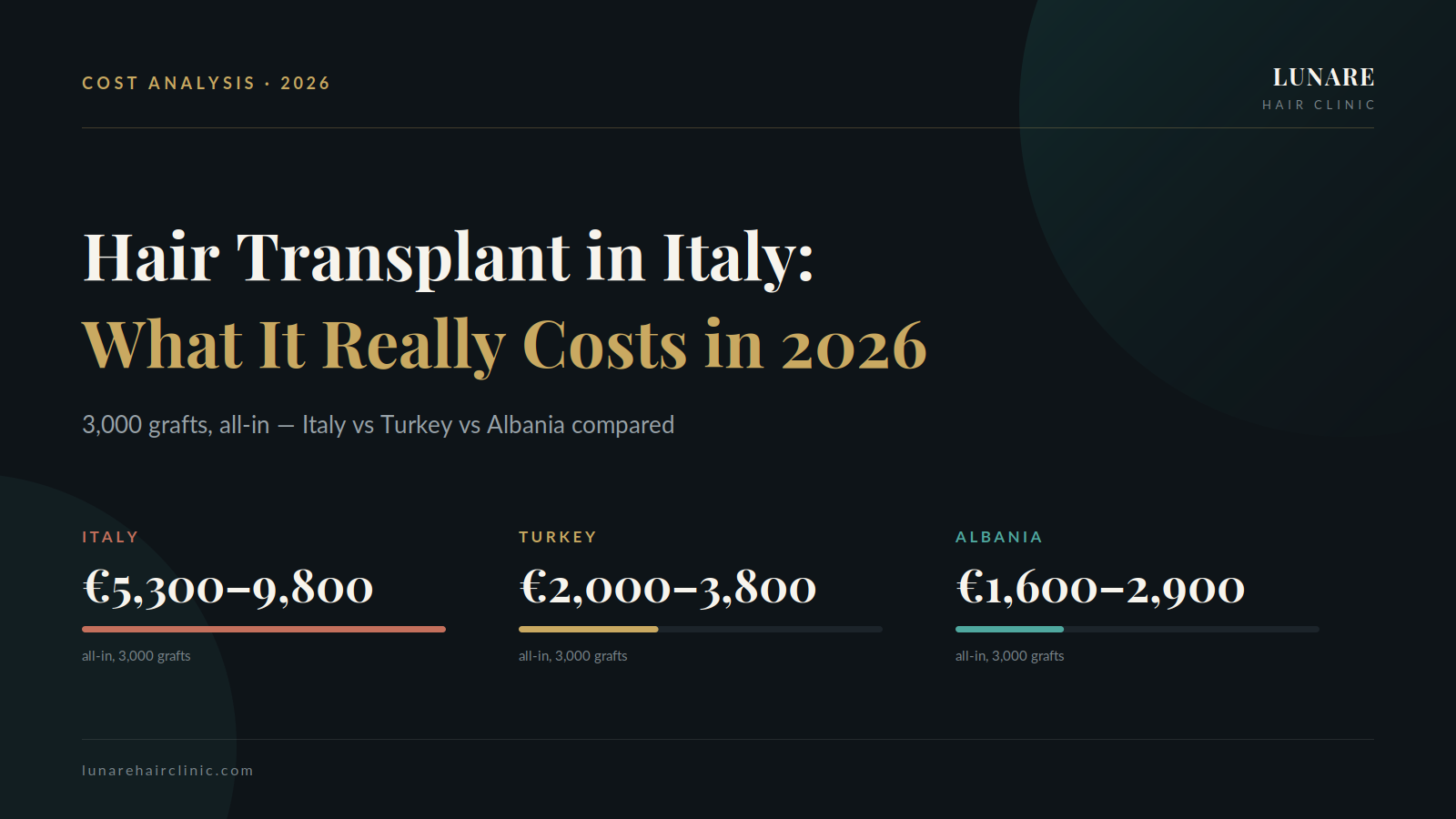
| Realistic all-in total | €5,300 – €9,800 | €2,000 – €3,800 | €1,600 – €2,900 |

The delta is not marginal. For the same clinical case, an Italian patient is looking at a difference of roughly €3,000 to €7,000 — the equivalent of a small car, or of the entire procedure repeated twice.
Â
The cost of hair transplants in Italy is not the only reason
A price difference of this scale for a hair transplant is reasonable only if the service purchased is comparable. However, there are a few variables to consider.
The first variable is who performs the transplant. In many high-volume clinics, technicians perform the extraction and implantation under the supervision of a surgeon who monitors multiple operating rooms simultaneously. This isn’t automatically a bad thing—experienced technicians can be excellent—but it must be disclosed, and the surgeon must design the hairline and be present. A clinic that doesn’t answer this question directly has already given its answer.
Furthermore, in Italy, it’s less common to find an all-inclusive package when it comes to hair transplants. The pattern observed in high-volume markets is a quote that changes on the day of the procedure: more grafts than agreed upon, an upgrade in technique, or a “premium” package presented at the operating table. A written, fixed quote issued before you arrive is your only protection.
It’s also important to remember that the costs should include a 12-month follow-up. A hair transplant isn’t complete when you leave the clinic. Hair shedding between the fourth and eighth weeks, growth by the fourth month, and final density by the twelfth month: this is the timeline, and it requires a doctor who is available throughout the entire period.
Let’s take an example: Albania’s alignment with the EU regulatory framework and the short flight times mean that an inspection visit is a weekend trip, not an expedition. This is a practical difference, not a marketing one.
This is the unique position Albania occupies: European clinical standards and Italian ancd Balkan prices, just ninety minutes from Milan, Bergamo, Bologna, Pisa, Rome, or Genoa, with entry requiring only an ID card—no visa needed. It’s not the cheapest option on the market. It’s the one with the smallest gap between price and reliability.
When staying in Italy is the better decision?
There are cases where travelling is the wrong call, and any clinic that tells you otherwise is selling rather than advising. Stay in Italy if:
- Your diagnosis is not confirmed: diffuse thinning, sudden shedding, or patchy loss may indicate telogen effluvium (like late-summer hair loss), alopecia areata or a scarring alopecia — none of which is treated by transplantation. See an Italian dermatologist first.
- You are a revision case with limited donor supply: Â repairing a poorly executed transplant is harder than performing one, needs multiple in-person assessments, and may require staged surgery.
- You have relevant comorbidities, Â anticoagulant therapy, uncontrolled diabetes, autoimmune conditions, requiring close local management.
- You need frequent in-person reassurance: if remote follow-up would cause you anxiety, that has a real cost, and it is not measured in euros.
- You are under 25: androgenetic alopecia is progressive. Operating too early often means operating again. Medical therapy first is usually the better strategy.
How to Find the Best Hair Transplant Clinic in Italy: 7 Criteria for Comparing Quotes
Looking for the lowest price in a quote is what leads patients to get the worst results, not the best. Finding the best hair transplant clinic in Italy means comparing the right factors—in the right order—not just the costs. Let’s look at the criteria to consider to help you make your choice.
- Total landed cost — procedure, VAT, flights, hotel, transfers, medication, lost workdays.
- Grafts guaranteed in writing, not estimated.
- Who operates, and whether the surgeon is named and verifiable.
- The follow-up schedule for the full 12 months.
- Reviews with dates and photographs, not testimonial text alone.
- The consent and complications documentation — a clinic that discusses risk in writing is a clinic that expects to be held to it.
- How the quote responds to a request for a written breakdown. The answer to that request tells you nearly everything.
Frequently asked questions
How much does a hair transplant cost in Italy in 2026?
Between roughly €3,000 and €10,000, depending on graft count. Localised cases under 2,000 grafts start around €3,000; extensive cases above 4,000 grafts commonly exceed €8,000. Add 22% VAT where no therapeutic attestation is issued.
Why is a hair transplant so much cheaper abroad?
Labour and facility costs, package pricing that flattens the per-graft curve, and VAT treatment. In Albania a complete package including flights and accommodation typically totals €1,600–€2,900 for a case that costs €5,000–€8,000 in Italy.
Is a hair transplant covered by the Italian national health service?
No. Androgenetic alopecia is not treated as a condition requiring surgical intervention under the SSN, so the procedure is entirely private.
Can I deduct the cost from my taxes?
Generally not. The 19% medical deduction requires a documented therapeutic purpose; hair transplantation is normally classified as aesthetic. Verify your specific position with a tax advisor.
Is it safe to have a hair transplant abroad?
Safety depends on the clinic, not the country. The variables that matter are the same everywhere: a named and verifiable surgeon, a written fixed quote, disclosure of who performs extraction and implantation, and a defined twelve-month follow-up schedule. Apply those four tests identically to an Italian clinic and a foreign one.
Â
Getting an accurate number for your case
Every figure in this article is a market range. The only number that matters is the one calculated for your donor area, your Norwood stage and your density goal. Lunare Hair Clinic operates in Tirana with FUE and DHI procedures performed by named surgeons, Italian-speaking coordination throughout, and packages that include flights and two nights’ accommodation — quoted as one fixed figure before you travel, with no revision on the day of surgery.Your new hair begins with a free conversation.
Table of Contents

Shock Loss After a Hair Transplant: Why Hair Falls Out and How Long It Takes to Grow Back
Why hair falls out in month two after a transplant, how long shock loss lasts, donor area shedding, risk factors and the signs that it is not shock loss.

Hair Transplant in Turkey: Real Reviews, Risks and What Low-Cost Packages Hide
Planning a hair transplant in Turkey? Check the 8 questions every serious clinic answers in writing before you pay a deposit. Don’t book blind.

Androgenetic Alopecia and Norwood Scale: Stages, Symptoms and When to Intervene
How to recognise androgenetic alopecia, what each Norwood stage looks like and from which stage a hair transplant makes sense. Clear, sourced guide.
FAQ
Am I a good candidate for a hair transplant?
Most patients with stable hair loss and a sufficient donor area are good candidates. During the online evaluation, our doctors will analyze your photos and medical history to confirm whether a transplant is recommended and which technique fits best.
Is the hair transplant painful?
he procedure is performed under local anesthesia. You may feel mild discomfort when the anesthesia is injected, but the surgery itself is usually well tolerated. After the procedure, you may experience slight tension or sensitivity, which is managed with medication.
How long does the procedure take?
Depending on the number of grafts, a hair transplant typically takes between 4 and 8 hours, including breaks and preparation
When can I go back to work?
Many patients return to desk work after 3–5 days. If your job is physically demanding or involves sun exposure, you may need a longer break. Our team will give you tailored advice.
What do you mean by “guaranteed results”?
By “guaranteed results” we mean that we stand behind our work with:
- clear, realistic expectations before the surgery
- a written aftercare plan
- structured follow-up to monitor your progress
In specific cases, if results are significantly below expectations despite correct aftercare, our medical team may propose additional corrective sessions or solutions.
Is Albania safe for medical tourism?
Yes. Albania has become an increasingly popular destination for medical tourism thanks to modern clinics, qualified doctors and competitive prices. At Lunare Hair Clinic we work with strict hygiene standards and offer full logistical support for your stay.
What’s the difference between FUE, FUT and DHI?
FUT (Strip method)
Â
-
A strip of skin is removed from the donor area, then divided into follicular units.
-
Leaves a linear scar on the back of the head.
-
Usually allows a large number of grafts in a single session.
Â
FUE (Follicular Unit Extraction)
Â
-
Individual follicles are extracted one by one using a micro-punch.
-
No linear scar, only tiny dot scars, usually invisible with short haircuts.
-
Faster recovery and less post-op discomfort compared to FUT.
Â
DHI (Direct Hair Implantation)
Â
-
Uses FUE to extract grafts, but implantation is done with special implanter pens.
-
Allows very precise control of angle, direction and depth of each hair.
-
Particularly suitable for hairline design and detail work.
Â
You can think of DHI as an “evolved” way of implanting FUE grafts, not a completely separate transplant method.
When will I see results?
Hair transplant results follow a clear timeline:
Â
-
0–2 weeks: healing and formation of scabs
-
1–3 months: temporary shedding of transplanted hairs (normal process)
-
3–6 months: first new hairs start growing
-
6–9 months: visible improvement in density
-
9–12 months: final result in most patients
Â
So you need patience: it’s a long-term investment, not an instant makeover.
Are the results permanent?
Transplanted hair is taken from areas genetically more resistant to baldness, so it usually keeps growing for life.
However, non-transplanted hair can continue to thin over time. That’s why stabilizing hair loss (with medical therapy when indicated) and planning a long-term strategy with your doctor is important.
What are the main risks or possible complications?
When performed by experienced doctors in a proper medical setting, hair transplant is generally safe, but as with any medical procedure there are potential risks:
Â
-
Swelling and bruising
-
Temporary numbness or sensitivity
-
Infection (rare with correct hygiene)
-
Folliculitis (inflammation of follicles)
-
Suboptimal growth or density if aftercare instructions are not followed or if grafts are not handled correctly
Â
A serious clinic will explain risks clearly and give you written post-op instructions.