

Most men who start losing their hair ask themselves two questions: is this real baldness or just a temporary phase? And how far could it progress? Androgenetic alopecia, also known as androgenetic baldness, is the most common cause of hair loss in both men and women, and it follows a predictable course. It is precisely this predictability that makes the Norwood scale so useful: it turns a vague worry into a precise stage, and a precise stage into a concrete plan. In this guide you will find the signs to recognise it, how a doctor confirms it, the stages of the Norwood scale one by one and when a hair transplant really makes sense.
Key takeaways
- Androgenetic alopecia is genetic and hormone-driven: follicles shrink progressively (miniaturisation) under the effect of DHT.
- In men it starts at the temples and/or the crown; in women it thins the top of the head while the frontal hairline is usually preserved.
- The Norwood scale has 7 stages plus variants (3 Vertex and the “A” types). Stage 3 is the first stage clinically considered baldness.
- A doctor confirms the diagnosis with a scalp examination and trichoscopy, not with a mirror.
- Your stage, your age and the quality of your donor area — not the stage alone — decide whether a hair transplant makes sense.
Androgenetic alopecia: what is it?
Androgenetic alopecia is a genetically predetermined condition caused by an excessive response of the hair follicles to androgens (StatPearls, NCBI). The key hormone is dihydrotestosterone (DHT), produced from testosterone by the enzyme 5-alpha-reductase. In genetically sensitive follicles, DHT shortens the growth phase of the hair cycle. Each new hair grows back thinner, shorter and lighter until the follicle produces only a fine, almost invisible vellus hair. This process is called miniaturisation.
- Two practical consequences follow. First, the hair does not “fall out” all at once: it fades. Many people notice a see-through scalp under bright light long before they notice a bald patch. Second, the follicles at the back and sides of the head are genetically resistant to DHT. This is why they survive even in the most advanced stages, and why they can be used as a donor area in a hair transplant.
It is also very common. By the age of 50, more than half of Caucasian men show visible signs of male pattern hair loss (US Pharmacist). Common does not mean trivial: the earlier it starts, the more time it has to progress.
How to recognise androgenetic alopecia: 6 signs you can check at home
Early androgenetic alopecia (the stage often called early or premature baldness) is easy to confuse with seasonal shedding. These are the signs that point towards a pattern, not a phase:
- The temples are moving back: compare a photo from 3–5 years ago with one taken today, same angle and light. A hairline that forms a deeper “M” is the most typical first sign in men.
- The crown shows through: ask someone to photograph the top-back of your head. A lighter, round area at the vertex is the second classic starting point.
- The hairs are getting thinner, not just fewer: hairs of different thickness in the same area — some normal, some fine and short — are the visible trace of miniaturisation.
- The frontal forelock is thinning: in many men a central island of hair resists longer than the temples, then thins in turn.
- It has lasted for months and it follows a pattern: seasonal or stress-related shedding is diffuse and temporary. Androgenetic alopecia is localised and progressive.
- There is a family history: hair loss in your father, grandfathers or maternal uncles raises the probability, although it does not predict your exact pattern.
Losing hair in the shower or on the pillow is not a diagnosis in itself. Shedding 50–100 hairs a day is normal, and a spike after summer, a fever or a stressful period is usually telogen effluvium, which recovers on its own. We explain the difference in our guide to late-summer hair loss.
What Androgenetic Alopecia Is Not: conditions that are similar to It
Not every form of baldness is due to androgenetic alopecia. The most common cases are telogen effluvium (diffuse loss after a triggering event), alopecia areata (round, well-defined bald patches, often appearing quickly) and traction alopecia (caused by hairstyles that are too tight). In women, hair loss can also be linked to thyroid problems, iron deficiency or hormonal conditions such as polycystic ovary syndrome. The treatment is completely different in each case, which is why a medical diagnosis comes before any decision.
How the Doctor Confirms the Diagnosis of Androgenetic Alopecia?
In most men, a careful medical history and a scalp examination are enough to diagnose androgenetic alopecia. In women, the examination should be completed with trichoscopy (Kuczara et al., systematic review, 2024). A specialist assessment usually includes:
- Medical history: when it started, how fast it is progressing, family history, medications, recent illnesses or stress, diet.
- Pattern examination: where the thinning is concentrated and how it compares with the back of the head.
- Trichoscopy: a magnified, non-invasive examination of the scalp. The hallmark of androgenetic alopecia is hair shaft thickness heterogeneity (anisotrichosis). Most studies use a threshold of more than 20% of thinner hairs in men and more than 10% in women as a diagnostic criterion.
- Pull test: a gentle traction on a lock of hair to assess active shedding.
- Blood tests, when indicated: mainly in women or in atypical cases, to rule out thyroid, iron or hormonal causes.
Trichoscopy also has a practical value for anyone considering a transplant: it measures the density and thickness of the donor area, which is the real limit of what surgery can achieve.
The Norwood scale: why doctors still use it?
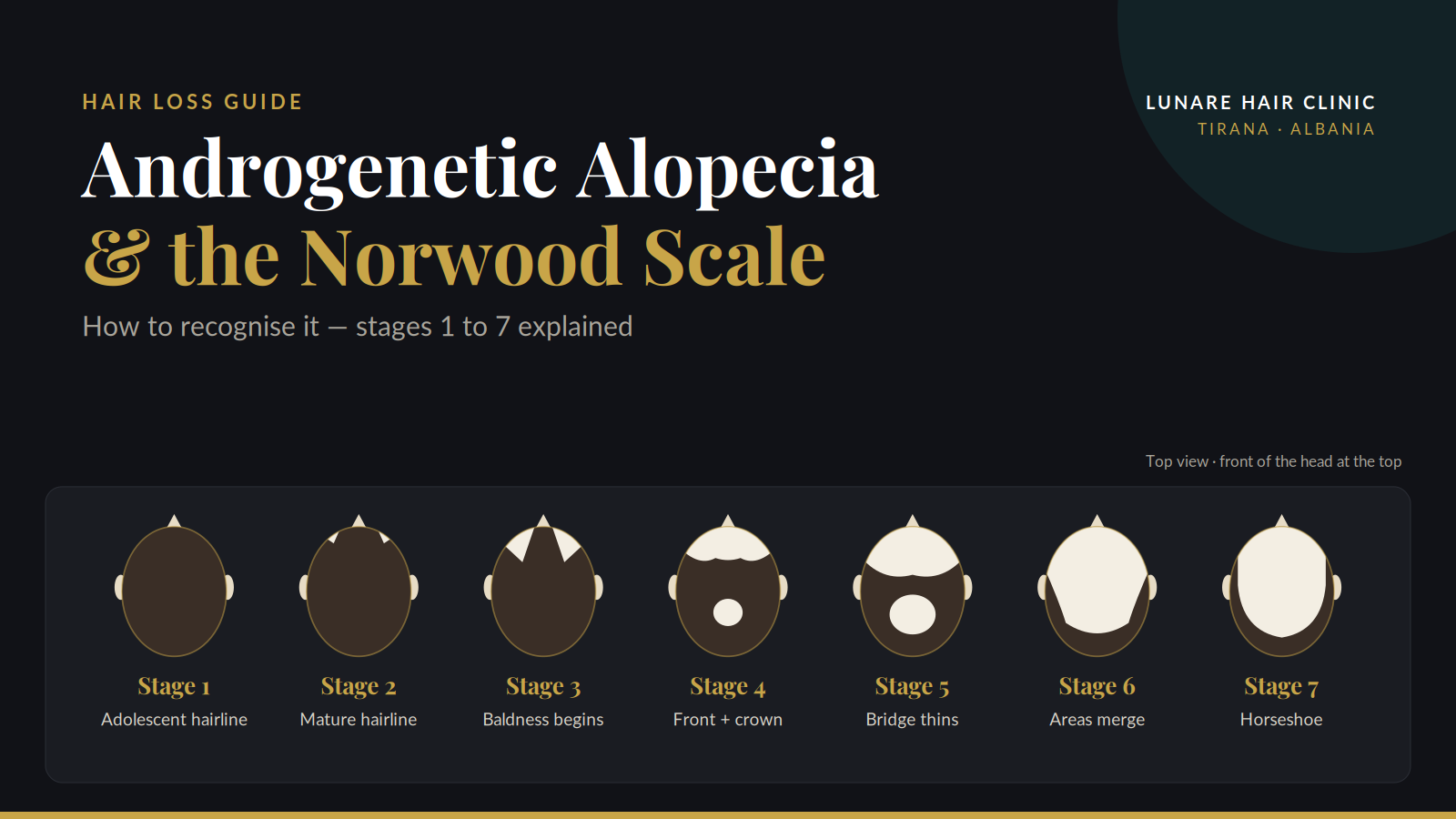
The first systematic classification of male pattern baldness was published by James Hamilton in 1951. In 1975 the surgeon O’Tar Norwood refined it after studying hair loss in 1,000 men, adding the vertex and “A” variants (Norwood OT, South Med J 1975; review in JCAS). The result, known as the Hamilton-Norwood scale or simply the Norwood scale, is still the most widely used classification in the world. Doctors use it to describe hair loss in a shared language, to select patients for clinical trials and to plan hair transplants.
Here is the whole scale at a glance, followed by a detailed description of each stage.
| Stage | What you see | Typical clinical approach* |
|---|---|---|
| 1 | No recession, or minimal recession of the hairline | Monitor; baseline photos if there is a family history |
| 2 | Small, symmetrical triangular recessions at the temples | Medical evaluation; transplant rarely needed |
| 3 / 3 Vertex | Deep temple recessions (3) or crown thinning with mild recession (3V) | Medical therapy; transplant possible if loss is stable |
| 4 | Frontal recession + thinning crown, still separated by a band of hair | Transplant commonly considered, with medical therapy |
| 5 | Larger front and crown areas; the separating band is narrow and sparse | Transplant; donor area capacity becomes decisive |
| 6 | The band disappears: front and crown merge into one area | Transplant prioritising front and mid-scalp |
| 7 | Only a horseshoe of hair remains on the sides and back | Selected cases; coverage limited by the donor area |
*Indicative only. The right option depends on age, stability of the loss, donor area and personal goals, and is defined during a medical consultation.
Norwood 1: the adolescent hairline
There is little or no recession along the front of the hairline. This is the reference point, not a form of baldness. If hair loss runs in your family, the only useful action at this stage is to take standardised photos (front, temples, top, crown) once a year, so that any change is measurable.
Norwood 2: the mature hairline
Small, usually symmetrical triangular recessions appear at the temples. For many men this is simply the transition from an adolescent to an adult hairline and it can stop here. It is worth a medical evaluation if the recession is progressing year after year or if the hairs in that area are getting finer.
Norwood 3: the first stage of clinical baldness
Norwood defined stage 3 as the minimum degree of hair loss sufficient to be considered baldness. The temple recessions are deep, symmetrical and bare or only sparsely covered. This is the stage at which most men start searching for solutions, and the stage at which the choice between medical therapy, waiting and a transplant needs to be made with a doctor, not with a forum.
Norwood 3 Vertex (3V) is a variant in which the hair loss is mainly at the crown, with a frontal recession no deeper than stage 3. Crown loss is harder to see in the mirror, so photos taken from above are essential.
Norwood 4: front and crown, still separated
The frontal recession is more severe than in stage 3 and the crown is sparse or bald. A band of moderately dense hair still runs across the top of the head, separating the two areas and connecting the sides. Stage 4 is often considered a good moment for a transplant, because the pattern is clear and the donor area is usually sufficient to restore the front and part of the mid-scalp.
Norwood 5: the bridge thins out
Both the frontal and the crown areas are larger. The band between them is narrower and sparser, but the two areas are still separated. From this stage onwards, the number of grafts that the donor area can provide becomes the real limit, and the plan has to establish priorities: the front of the head frames the face and is usually restored first.
Norwood 6: front and crown merge
The bridge has disappeared. The front, the mid-scalp and the crown form a single bald area, which also extends towards the sides. A transplant can still give a natural result, but it rarely restores the original density everywhere. Setting realistic expectations before the procedure is part of good medicine.
Norwood 7: the horseshoe
This is the most advanced stage. Only a horseshoe-shaped band of hair remains on the sides and back of the head, and it may itself be thin. Surgery is possible only in selected cases with a good donor area, and the goal is framing the face rather than full coverage.
The “A” variants (2A–5A): when the whole hairline moves back
In the A variants the entire front hairline recedes as a single line, from front to back, without the typical “M” shape and without a separate bald spot at the crown. There is no central forelock resisting longer than the temples. The A pattern is less common but important in transplant planning, because the loss concentrates at the front, where results are most visible.
Androgenetic alopecia in women: the Ludwig scale
The Norwood scale does not apply to women. Female androgenetic alopecia is usually more diffuse: the hair thins on the top of the head while the frontal hairline is preserved. Doctors classify it with the Ludwig scale, which has three grades:
- Ludwig I: mild thinning on the top of the head; the parting looks wider.
- Ludwig II: marked thinning and reduced volume on the top of the head.
- Ludwig III: extensive thinning, with the scalp clearly visible on the top of the head.
In women, blood tests and trichoscopy are especially important, because other causes (thyroid, iron deficiency, hormonal changes after pregnancy or menopause) can mimic or add to androgenetic alopecia. A transplant is an option only in selected cases with a stable pattern and a good donor area.
Early and premature baldness: why the stage at 25 is not the final stage
When androgenetic alopecia appears in late adolescence or around the age of twenty, the current stage says little about where it will stop. An early onset simply means that many years of progression still lie ahead.
This is why, in the early phases, medical therapy carries decisive weight: there are still many miniaturised follicles that can be protected, and treatment must be prescribed and monitored by a doctor. At the same time, a transplant performed too early can look unnatural in the years that follow. If a Norwood 2 hairline is rebuilt and the loss progresses to Norwood 5, a gap can form behind the transplanted area. A good surgeon plans with future progression in mind, not just the current situation.
From stage to plan: when a hair transplant makes sense
The Norwood stage is only one of four factors. A doctor considers them together:
- Stage and pattern: how much area needs to be covered and where.
- Stability: whether the loss has slowed down, often with the support of medical therapy.
- Donor area: density and hair thickness at the back and sides of the head, the only true “budget” of grafts available.
- Age and expectations: a plan that still looks natural in 10–15 years.
Once these are defined, the choice of technique follows. Our guide to FUE vs DHI explains which technique suits which case, and you can see all the procedures we perform on the treatments page. If you are weighing up where to have the procedure, read our comparisons of hair transplant costs in 2026 and of Albania vs Turkey.

Androgenetic Alopecia and Norwood Scale: Stages, Symptoms and When to Intervene
How to recognise androgenetic alopecia, what each Norwood stage looks like and from which stage a hair transplant makes sense. Clear, sourced guide.

Hair Transplant in Tirana: A Practical Guide to Flights, Accommodation and How Many Days You Need
Once you have decided that a hair transplant abroad makes sense, medical doubts are usually cleared up quickly. It is the practical ones that hold

Hair Transplant Before & After: Month by Month
What a hair transplant really looks like month by month: shedding, shock loss, regrowth at 3-6 months and the final result at 12-18. With photo protocol.
 English
  Italian