Once you have decided that a hair transplant abroad makes sense, medical doubts are usually cleared up quickly. It is the practical ones that hold back the booking: how many days off work you need, which airport to choose, which documents to bring, where to sleep and whether you can leave the hotel after the procedure.
This guide answers those questions for anyone turning to a hair clinic in Tirana. It is written from the clinic’s side, so it tells you what really happens day by day and where the limits are. You will find direct flights from the main Italian cities, the documents you need, accommodation and what to see in Tirana in one, two or three days without putting your grafts at risk. Medical tourism in Albania works well precisely because the logistics are simple. It is not a holiday, though: the days after the procedure have precise rules, and the itinerary you plan must respect them.
The short answer: most patients need 3 days and 2 nights in Tirana. At Lunare Hair Clinic, the package includes flights, airport transfers and two overnight stays, so the trip is organised around the date of the procedure, not the other way round.
How many days do you need in Tirana for a hair transplant?
A standard FUE or DHI session fits into three days. The table below is the sequence most patients follow.
| Day | What happens | What you can do |
|---|---|---|
| Day 1 — Arrival | Flight to Tirana, transfer to the hotel. Consultation and pre-operative checks, on arrival day or early the next morning depending on your flight time. | Free afternoon/evening. This is the only day with no restrictions. |
| Day 2 — Procedure | The procedure takes most of the day (typically 6–8 hours, depending on the number of grafts). Local anaesthesia, breaks for meals. | Rest at the hotel. No walking tours. |
| Day 3 — Instructions and departure | You receive written instructions for the following days, including how and when to do your first wash at home. Transfer to the airport. | Short, shaded walks before your flight. |
Three situations justify adding a night:
- Large sessions or complex cases: when the graft count is high or the case is a revision, the surgeon may want a longer observation window before you fly. This is decided at the assessment stage, not improvised on the day.
- Unfavourable flight times. If the available return flights do not fit the schedule — for example, a departure very early on Day 3 — an extra night is usually the cleaner solution.
- Combined treatments: adding a beard or eyebrow procedure, or a PRP session, can change the schedule. Ask your coordinator to confirm the plan in writing.
What you do not need is a week. Some clinics recommend five to seven days in Tirana. For a standard session, that time adds hotel costs and holiday days without adding clinical value: once you have your instructions, the follow-up continues remotely and at scheduled checks.
See what to expect week by week and month by month after the procedure.
Back at work: most people with desk jobs return after 7–10 days, when the scabs have fallen off. Jobs involving physical effort, heat or helmets need a longer break — your surgeon will give you a specific date.
Flights to Tirana from Italy from Genoa, Bergamo, Rome and Catania
Tirana International Airport Nënë Tereza (TIA) is the arrival airport for almost all patients. It is roughly 15–20 km from the city centre, and the transfer takes around 20–30 minutes depending on traffic. Tirana is in the same time zone as Italy, so there is no jet lag to factor into the procedure day.
Direct flights leave from most major Italian airports, from the north to Sicily. Here are the four routes our patients use most, from the north, the centre and the south of Italy.
| Departure airport | Direct carriers | Flight time | Frequency |
|---|---|---|---|
| Genoa (GOA) | Wizz Air, Ryanair | approx. 1h30–1h45 | Daily direct flights |
| Milan Bergamo (BGY) | Wizz Air, Ryanair | approx. 1h40–1h45 | 5–6 direct flights a day |
| Rome Fiumicino (FCO) | ITA Airways, Wizz Air | approx. 1h25–1h35 | Several direct flights a day |
| Catania (CTA) | Ryanair, Wizz Air | approx. 1h15–1h25 | Daily direct flights |
Airlines and schedules change seasonally. Always check current timetables before confirming dates.
1. Flights to Tirana from Genoa
Genoa–Tirana is one of the shortest international routes from Liguria: about an hour and a half in the air. Direct flights are operated daily by Wizz Air and Ryanair, with average fares on comparison sites of around €110–120 one way. For those coming from Liguria or lower Piedmont, it is often faster, door to door, than driving to a Milan airport.
2. Flights to Tirana from Bergamo
Milan Bergamo (Orio al Serio) has the widest choice: five to six direct departures a day, spread from morning to evening. This makes it the most flexible option for patients from Lombardy, Veneto and Emilia, and the easiest route to rebook if dates move. The flight takes about 1 hour 40 minutes.
3. Flights to Tirana from Rome
Rome Fiumicino has direct flights to Tirana every day, operated by ITA Airways and Wizz Air, with a flight time of about an hour and a half. It is the most convenient route for patients from Lazio, Umbria, Abruzzo and Campania.
4. Flights to Tirana from Catania
Catania–Tirana is the shortest of the four routes: about 1 hour 20 minutes in the air, with daily direct flights by Ryanair and Wizz Air. For patients from Sicily it removes the need to connect through Rome or Milan. Departure times are spread across the day, but some flights leave very late in the evening: check the arrival time in Tirana before booking, so that your arrival day is not cut short.
Other Italian airports with direct connections to Tirana include Bologna, Pisa, Turin and several airports in southern Italy. If you are flying from elsewhere, the logic is the same: a short, direct flight on the same time zone.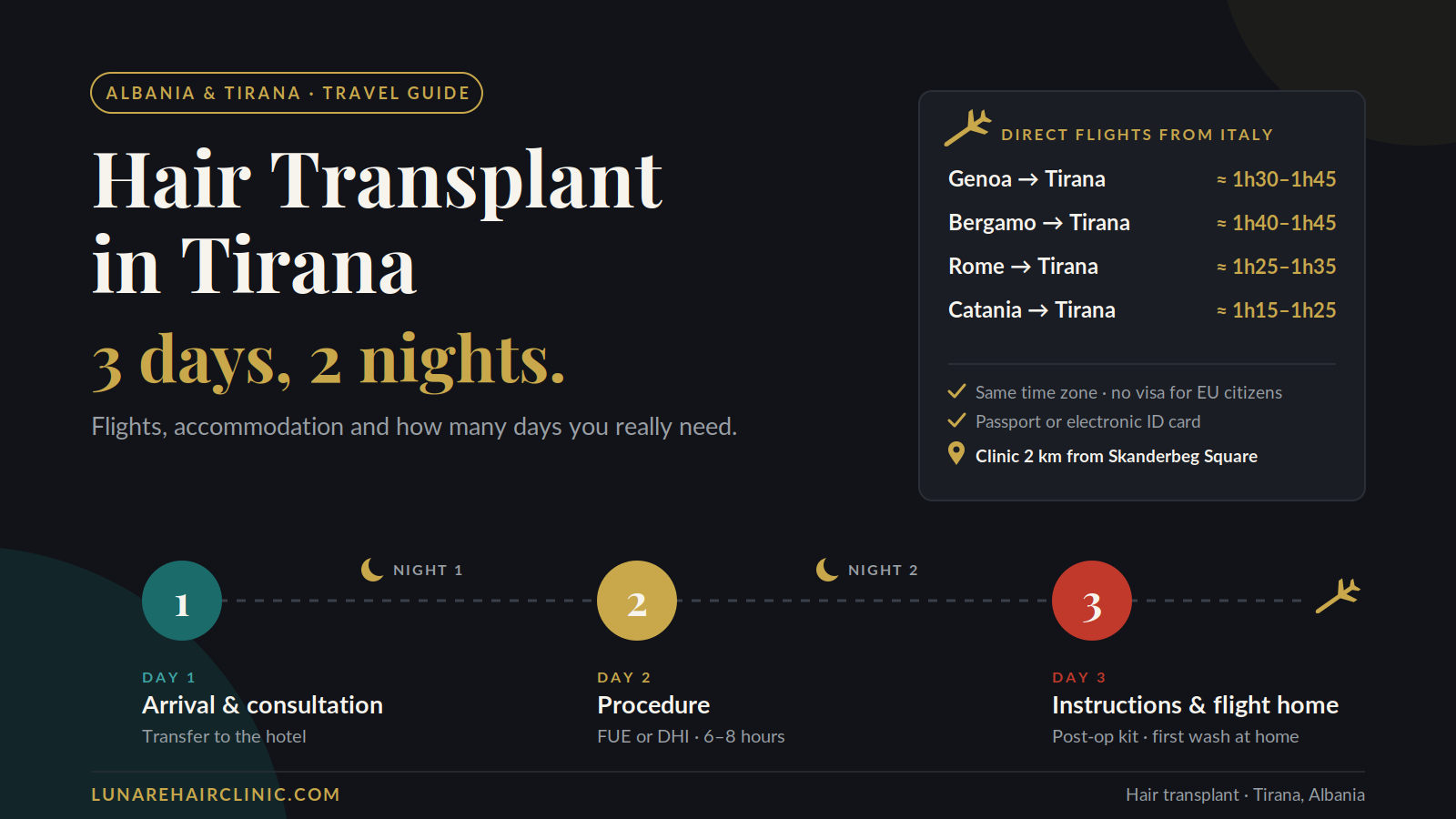
Flights to Tirana Low Cost: When to Book
Your flights are included in a Lunare package, so this section matters mostly if someone is travelling with you, or if you want to extend your stay.
- Book about 6 weeks ahead: flight comparison data for Italian routes to Tirana consistently places the best prices around 40 days before departure.
- Avoid July and August: summer is peak season for flights to Albania; autumn and early spring are cheaper and also better for recovery (less heat, less sun).
- Never buy non-refundable tickets before the surgery date is confirmed: the procedure date comes first; the flight is booked around it.
- Check the baggage rules: after the procedure you should avoid lifting heavy bags overhead. An under-seat bag or a checked bag is more practical than a large cabin case you will need to lift into the overhead locker.
Documents for Albania for a Hair Transplant: Passport or Identity Card?
For Italian and other EU citizens, entering Albania is simple, but there is one rule that catches people out.
- Accepted documents: a passport, or an electronic identity card (CIE) valid for travel abroad.
- Validity: the document must be valid for at least 3 months beyond your return date from Albania, and in good condition.
- Old paper ID cards: the Italian Ministry of Foreign Affairs states that no other documents are accepted. From 30 July 2026, Albanian authorities also accept the temporary paper document issued by Italian municipalities when you apply for a CIE (valid for up to 6 months). Check your card before booking — a document refused at the border means a cancelled procedure.
- Visa: EU citizens do not need a visa for short stays (up to 90 days in any 180-day period).
Always check the latest official guidance on Viaggiare Sicuri before you travel.
Arriving in Tirana: transfers, money and phone
- Transfer: in the Lunare package, the airport–hotel–clinic transfers are organised for you. You will not need to find a taxi or navigate public transport on the day you land or on the day of the procedure.
- Language: Italian is widely understood in Tirana, and the clinic’s coordination is available in Italian throughout your stay.
- Money: the local currency is the Albanian lek (ALL). Cards are widely accepted in the city centre; keep a small amount of cash for taxis, cafés and small shops.
- Phone and data: Albania is not yet part of the EU “Roam Like at Home” area. Negotiations were authorised in June 2026, but there is no set deadline. Check your operator’s rates before leaving or buy a travel eSIM. You will need working data: after the procedure, your coordinator and medical team will stay in touch on WhatsApp.
Where Our Hair Clinic in Tirana Is Located
Lunare Hair Clinic is in Tirana, south of the city centre, about 2 km from Skanderbeg Square. Open the exact location on Google Maps
You will not need to find your own way: the transfers from the airport to the hotel and from the hotel to the clinic are organised for you. Saving the location on your phone is still useful, especially if someone is travelling with you and wants to wait nearby or pick you up after the procedure.
Where to Stay in Tirana During Your Hair Transplant?
The two nights included in the package are in a hotel selected for proximity to the clinic. What makes a hotel suitable for a transplant patient is not the number of stars:
- Short distance to the clinic, so you are not exposed to sun, traffic or crowds on the day of the procedure and the day you leave.
- A quiet room and a lift, because the night after the procedure is the one where rest matters most.
- Extra pillows, to sleep with your head raised for the first nights. Bring a travel neck pillow if you have one.
- Room service or a restaurant on site, so you do not have to go out for dinner on the evening of Day 2.
If you plan to extend your stay before the procedure, the central districts — the area around Skanderbeg Square and Blloku — are the most practical. A dedicated guide to accommodation in Tirana is coming soon.
What to see in Tirana without putting your grafts at risk
The newly implanted grafts are vulnerable for the first days. Before planning any sightseeing, these are the rules your itinerary must respect after the procedure (your surgeon will confirm them for your specific case):
- No direct sun on the scalp. Choose indoor or shaded places, early morning or late afternoon.
- No sweating and no physical effort. No climbing, no long uphill walks, no gym.
- No bending forward or lifting weights.
- No hats or caps that press on the grafts, unless your surgeon has approved a specific loose-fitting one.
- No alcohol in the days immediately before and after the procedure.
- Avoid crowds where someone might bump your head.
With those limits in mind, here is what to see in Tirana depending on how long you have.
What to see in Tirana in one day
Best on Day 1, before the procedure — the only day with no restrictions.
- Skanderbeg Square, the heart of the city, and the Et’hem Bey Mosque on its edge.
- The Clock Tower, next to the mosque, for a view over the square.
- The Pyramid of Tirana, now a redeveloped public space you can climb for a view over the centre — do it today, not after the procedure.
- Blloku, the former residential district of the communist elite, now the city’s area for cafés and restaurants.
- The New Bazaar (Pazari i Ri) for dinner: a covered market area with traditional restaurants.
Note: the National History Museum on Skanderbeg Square is closed for renovation until 2028. You can still see the large mosaic on its façade from the square.
What to see in Tirana in 2 days
This is the plan that matches the standard stay. Two days in Tirana are enough to see the essentials if you use them well:
- Day 1 (pre-procedure): the one-day itinerary above.
- Day 3 (before your flight): indoor and shaded places only, close to the centre.
- Bunk’Art 2, a museum set in a former communist-era bunker near the Ministry of Interior. It is underground, cool and a short walk from Skanderbeg Square — practically designed for a post-procedure visit.
- The House of Leaves, the museum of secret surveillance, housed in the former headquarters of the communist secret police.
- A slow coffee in Blloku, sitting in the shade, before your transfer to the airport.
Keep it short. On Day 3 the priority is rest, the instructions and the flight; sightseeing is a bonus.
What to see in Tirana in 3 days
If your case requires an extra night, or you arrive a day early, the third day can be used for:
- The Dajti Ekspres cable car, up to Mount Dajti for a view over the city — only before the procedure, as the summit is exposed to sun and wind.
- Bunk’Art 1, the larger of the two bunker museums, near the base of the cable car.
- The Grand Park and the artificial lake, for a walk in the shade late in the afternoon.
- The National Archaeological Museum on Mother Teresa Square.
Opening hours of museums change during the year; check them close to your visit.
Hair Transplant Package in Tirana: What’s Included and What to Ask
A clear package is one of the signs of a serious clinic. At Lunare Hair Clinic, the package for international patients includes:
- Return flights
- Airport, hotel and clinic transfers
- Two nights of accommodation
- The procedure with the technique indicated for your case (FUE or DHI)
- Written post-operative instructions, including the washing protocol to follow at home
- Structured follow-up at 3, 6 and 12 months
Whichever clinic you choose, ask for these points in writing before paying a deposit: whether extra nights are included, what happens if a flight is cancelled, whether a companion can be added and at what cost, who performs each phase of the procedure, and what the final price is — fixed before you travel, not revised on the day of surgery. Here is what a hair transplant actually costs in Italy, Turkey and Albania.
What to Pack for Your Hair Transplant Trip to Tirana
- Passport or electronic ID card (valid for at least 3 more months after your return)
- Button-up or zip-front shirts, so you do not pull anything over your head after the procedure
- A travel neck pillow for sleeping with your head raised and for the flight home
- A list of the medications you take (to share with the medical team at the consultation)
- A phone with data for WhatsApp contact with your coordinator
- Some cash in lek for small expenses

Androgenetic Alopecia and Norwood Scale: Stages, Symptoms and When to Intervene
How to recognise androgenetic alopecia, what each Norwood stage looks like and from which stage a hair transplant makes sense. Clear, sourced guide.
Hair Transplant in Tirana: A Practical Guide to Flights, Accommodation and How Many Days You Need
Once you have decided that a hair transplant abroad makes sense, medical doubts are usually cleared up quickly. It is the practical ones that hold
Hair Transplant Before & After: Month by Month
What a hair transplant really looks like month by month: shedding, shock loss, regrowth at 3-6 months and the final result at 12-18. With photo protocol.
 English
  Italian