
Every hair transplant before-and-after photo you’ve ever seen is a lie by omission. Not because the images are fake, most of them are genuine, but because they show you two frames from a film that runs a full year. What happens in between is twelve months during which, for a while, things look worse than the day you walked into the clinic.
Patients arrive at week six convinced the procedure has failed, because the transplanted hair has fallen out and some of the hair they already had has fallen out along with it. It’s by far the most common reason people panic, start searching forums at 2am, and occasionally make expensive decisions they later regret.
This guide restores the missing frames: what actually happens to the scalp from the day of the procedure through month eighteen, what’s normal at each stage, what isn’t, whether you’ll need medication afterward, and how to honestly assess your own hair transplant results instead of comparing them to a marketing gallery.
Hair Transplant Before and After: a full timeline
Before getting into each phase in detail, it helps to see the whole year mapped out at once. The table below is the reference point everything else in this guide builds on — what a normal hair transplant before and after actually looks like, week by week, and what’s happening under the skin while you can’t see it.
| Period | What you see in the mirror | What is happening underneath |
|---|---|---|
| Day 0–2 | Redness, tiny crusts, possible forehead swelling | Grafts are anchoring; blood supply begins to form around them |
| Day 3–10 | Crusts flake off with washing, redness fading | Healing of extraction and implantation sites |
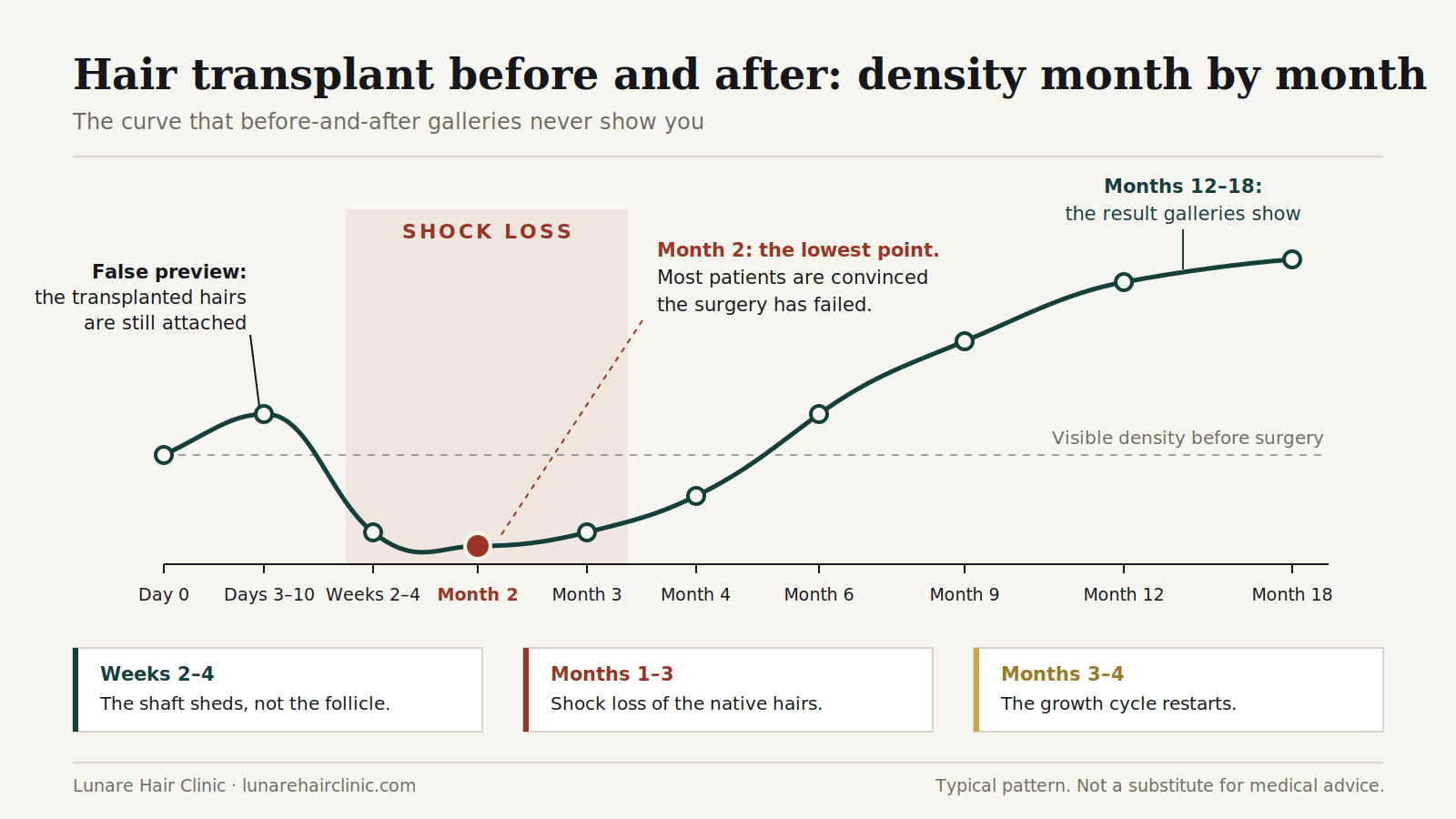
| Week 2–4 | The transplanted hairs fall out | The shaft sheds; the follicle stays alive below the surface |
| Month 1–3 | Shock loss. Sometimes thinner than before surgery | Native hairs pushed into the resting phase by surgical stress |
| Month 3–4 | First fine, sparse regrowth. Uneven | Follicles exit dormancy and restart the growth cycle |
| Month 4–6 | Visible coverage, still thin and patchy | New shafts growing roughly 1 cm per month |
| Month 6–9 | Real density. Hair thickens and darkens | Shaft calibre increases; more follicles catch up |
| Month 9–12 | The result most people call “final” | Frontal zone essentially mature |
| Month 12–18 | Crown and detail refinement | Slowest follicles complete the cycle |
Two rules follow from this table, and they matter more than anything else in this article:
- Do not judge your result before month twelve — month eighteen for the crown.
- A worse-looking scalp at month two is the expected path, not a deviation from it.
Day 0 to Day 10 After a Hair Transplant: What Happens?
You will leave the operating room with a densely dotted recipient area, a trimmed donor zone, and skin that looks aggressively pink. Over the first two or three nights, fluid can migrate downward and produce forehead or eyelid swelling.It seems worrying, but it resolves itself; sleeping on your back, avoiding turning your head and avoiding sleeping face down significantly reduces it.
Small crusts form around each implanted graft within 24 to 48 hours. They come away gradually during the washing protocol, which typically starts on day two or three and is done with a specific technique: no direct jet of water, no rubbing, no fingernails.
Here is the part that catches people out. In the first ten days, the transplanted hairs are still attached. Your hairline looks populated. Many patients photograph this and believe it is the result.
It is not. Those hairs are shafts sitting in follicles that have just been through a transplant, and almost all of them are about to fall out.
Weeks 2–4 After a Hair Transplant: Why Do Transplanted Hairs Fall Out?
Between roughly the second and fourth week, the hairs that were implanted start to fall out. In the shower, on the pillow, when you towel dry. Within a few weeks the recipient area can look almost as it did before surgery, minus the redness.
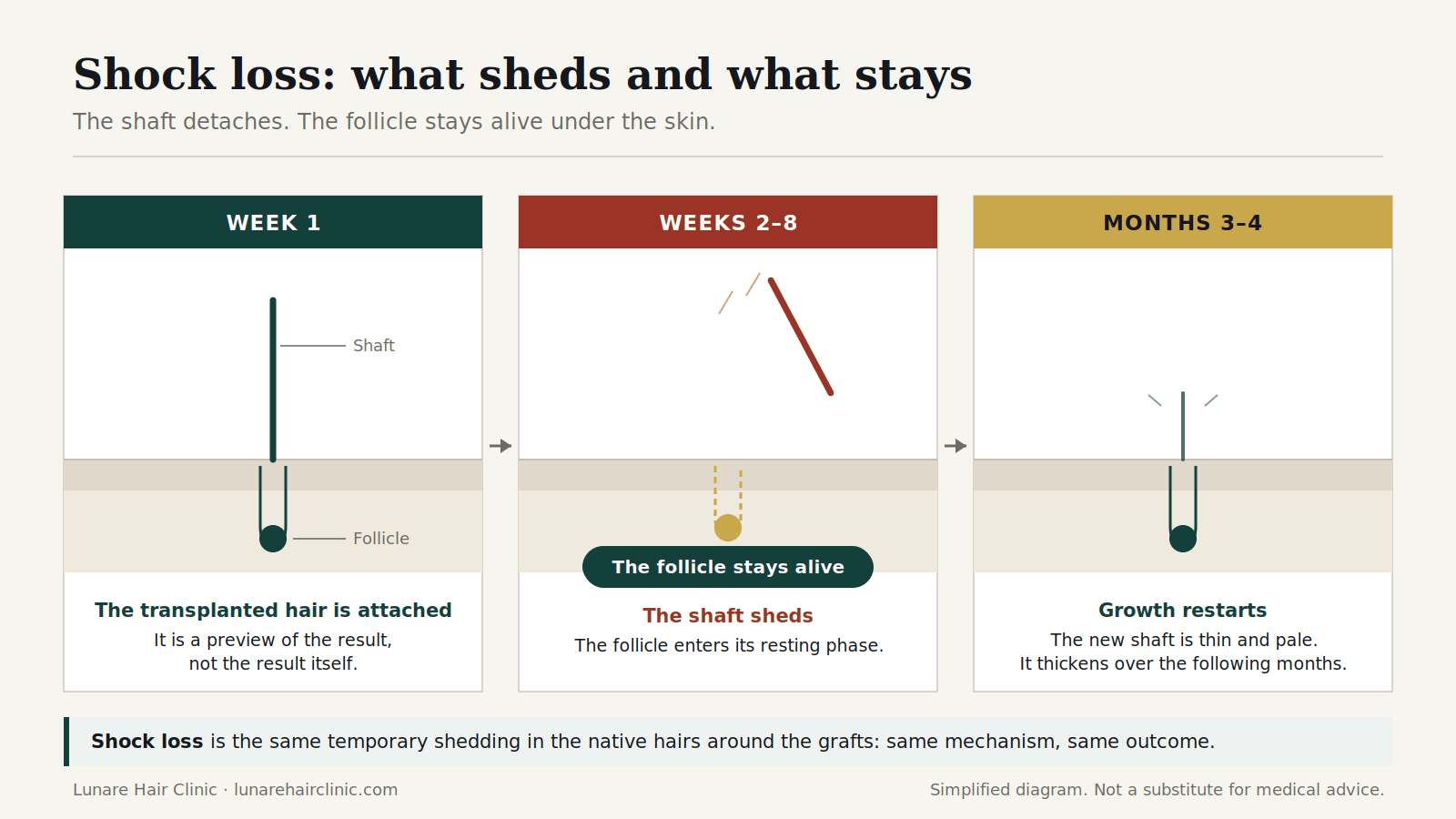
This is expected in the overwhelming majority of patients and it is not graft failure. What sheds is the hair shaft. What stays is the follicle, now settled into its new position, which enters a dormant phase before starting a fresh growth cycle. The American Society of Plastic Surgeons describes this same pattern in its patient guidance on hair transplant recovery: the newly placed hair commonly falls out within six weeks, after which several more weeks pass before growth resumes.
A useful mental model: you did not buy hair. You bought follicles. The hair is the output they will produce, on their own schedule.
Hair Transplant Shock Loss between 1 and 3 months: Is this normal?
Shock loss is where this article earns its title, because it is the stage that turns satisfied patients into anxious ones.
Shock loss is the temporary shedding of your own existing hair — not the transplanted hair — triggered by the surgical stress on the scalp. Clinically it is best described as a localised telogen effluvium: follicles are pushed prematurely out of their growth phase and into the resting phase, and the shafts are released a few weeks later. The International Society of Hair Restoration Surgery’s explanation of telogen effluvium covers the same mechanism in its general form, where the trigger is surgery, illness, childbirth or severe stress rather than a transplant specifically.
In the following in-depth sections, we’ll explore together how shock hair loss manifests, when it typically begins, how the recipient and donor areas differ, who is most at risk, and whether this phenomenon is permanent.
1. Hair Transplant Shock Loss Timing
Shock loss usually begins between weeks two and four, is at its most obvious around weeks four to eight, and resolves over the following three to six months as the affected follicles resume their cycle. Combined with the shedding of the transplanted hairs, the result is that month two is very often the thinnest your scalp will look in the entire process — thinner, sometimes, than before you had surgery.
2. Shock Loss in the Recipient Area vs the Donor Area
In the recipient area, the hairs most likely to shed are the ones that were already weak: miniaturised, thinning hairs affected by androgenetic alopecia, sitting between the newly placed grafts. They were on their way out anyway; surgery accelerated the timetable. Healthy, terminal hairs shed far less often.
In the donor area, is less common, less discussed, and more worrying to patients when it happens, because the back of the head was supposed to be the safe zone. Extraction disturbs the microcirculation around neighbouring follicles, and some of them respond by shedding. It typically appears within the first weeks as diffuse thinning or a faintly patchy look under short hair, and it typically recovers.
3. Who is most likely to experience hair loss after a transplant?
- Patients with a large amount of miniaturised native hair in the transplanted area
- Women, who more often undergo transplants into zones with substantial existing hair
- Cases with very dense packing of grafts
- Patients who stopped medical therapy shortly before surgery
- Anyone with a pre-existing, untreated telogen effluvium from another cause — the seasonal shedding we describe in our article on late-summer hair loss is the same mechanism from a different trigger
4. Is hair loss after a transplant permanent?
Usually not. The shaft goes, the follicle stays, and the cycle restarts.
The honest exception: hair that was already severely miniaturised may not come back, because it was nearing the end of its functional life independently of the surgery. This is not damage caused by the transplant — it is the underlying hair loss continuing on schedule, made visible all at once. It is also the single strongest argument for stabilising the native hair medically, which we come to below.
Persistent, well-defined patchiness in the donor area at twelve months is a different matter. That is more consistent with overharvesting than with shock loss, and it needs to be measured rather than guessed at. We cover how that assessment works in our guide to a failed hair transplant and revision surgery.
5. Loss of Transplanted Hair: When Should You Be Worried?
If you’ve noticed unusual hair loss or have any concerns, you should always consult the clinic where you had the procedure performed. In particular, contact your clinic within a few days—not months—if you notice:
- Spreading redness with pain, warmth or swelling that worsens instead of improving
- Pus, yellow discharge, or crusts that return after the scabs have cleared
- Fever
- Dark, dusky or blackened skin in the recipient area
- Sudden, sharply defined patchy loss in the donor area that does not fit the timeline above
These are potential complications, not stages of recovery.
Hair Transplant Regrowth: Months 3 to 6
Somewhere between month three and month four, the first new hairs break through. They are thin, pale, sparse and frequently wiry or curly in a way your hair has never been. They emerge at different times across the scalp, so coverage looks blotchy by design rather than by accident.
Hair grows at roughly one centimetre per month, which sets a hard ceiling on how fast this can improve. By month six most patients have something in the region of half the final density, with shafts that are still finer than they will eventually be. Photographs at this stage are genuinely encouraging compared with month two, and genuinely disappointing compared with the gallery that persuaded you to book.
The texture normalises. The colour deepens. Both take time.
Hair Transplant 6 to 12 Months Later: Here Are the Results
This is where the transformation becomes obvious to other people rather than just to you.
Between months six and nine, two things happen simultaneously: more follicles complete their first cycle and start producing hair, and the hairs already growing increase in calibre. That second factor is underrated — the visual density of a head of hair depends as much on shaft thickness as on the number of shafts. The same graft count looks dramatically fuller at month nine than at month six for exactly this reason.
By month twelve, the frontal third and mid-scalp are essentially mature in most patients. This is the point at which a before-and-after comparison is finally meaningful, and the point at which a clinic should be conducting a formal review with you.
Months 12 to 18: the crown, and the final step
The crown is slower. The whorl pattern means hair has to cover a surface in every direction from a central point, so it needs more density to look full, and its follicles tend to finish the cycle later. Twelve to eighteen months is a realistic window for the crown, and judging it at month nine will make you unhappy about a result that is still arriving.
Month eighteen is also the point at which any genuinely disappointing outcome can be assessed properly — with measurements, not impressions.
How to Photograph Your Own Hair Transplant Before and After?
Most patients’ “my result is bad” panic is a photography problem. Scalp appearance is enormously sensitive to light angle, hair length, and whether the hair is wet. A ceiling light directly overhead will make anyone look like they are balding.
Build your own comparison set properly and you will be able to see real change at month five that you cannot perceive in the mirror.
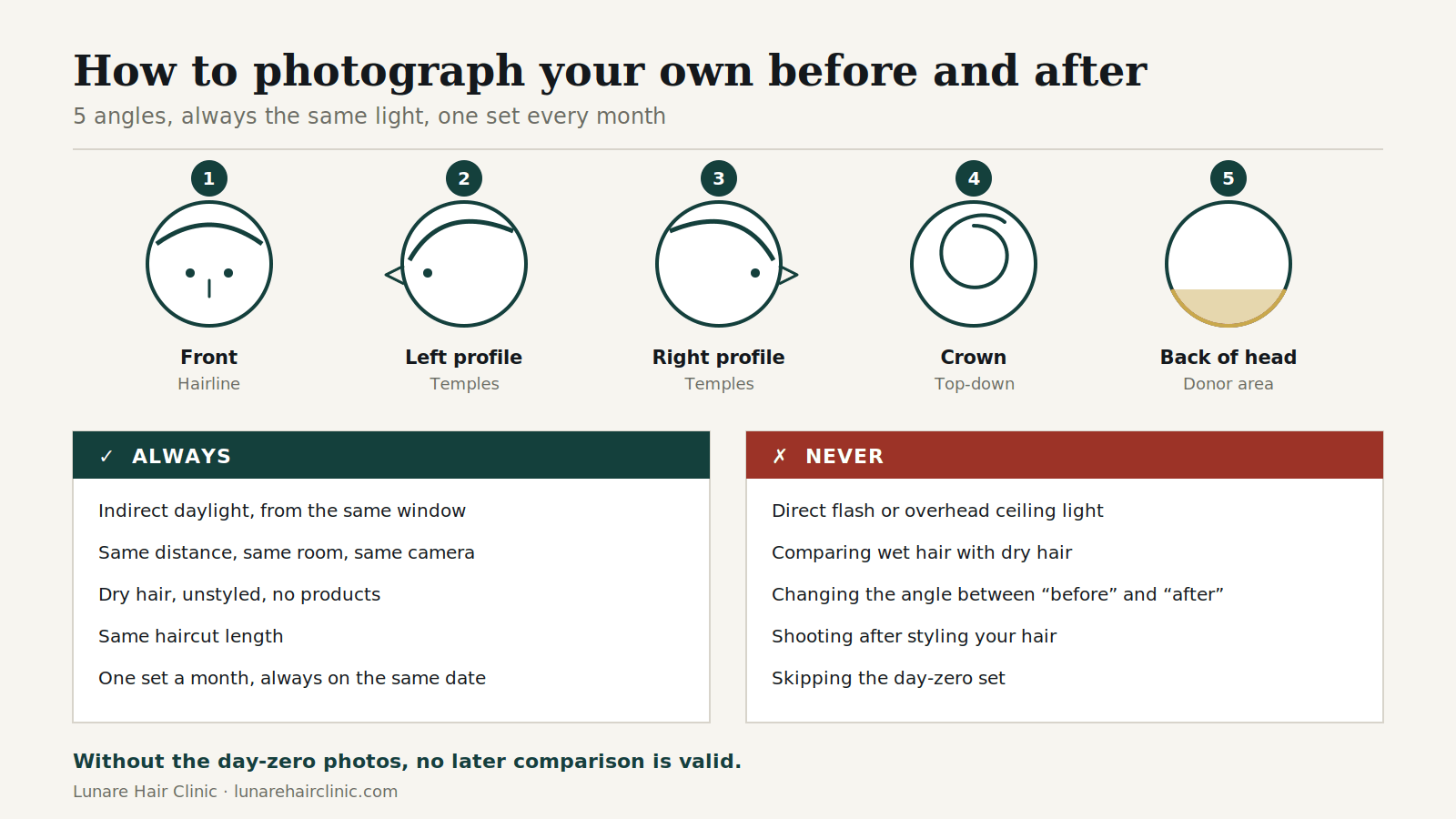
The protocol:
- Baseline on day zero: immediately after the shave and before surgery. Without a baseline, nothing afterwards is comparable.
- Five angles every time: front, left profile, right profile, top-down on the crown, back of the head for the donor area.
- Same light source, always: daylight from a window, indirect, no flash, no overhead spotlight. Same room, same time of day.
- Same distance and same camera: ask the same person to take them, or use a tripod and timer.
- Dry hair, natural fall, not styled: styling products are the main reason a month-nine photo flatters and a month-two photo does not. If you also want wet photos, that is useful — but compare wet with wet.
- Same hair length: a tight fade changes perceived density more than three months of growth does.
- Monthly, on the same date: name each file with the date and the month number.
This is also the set of photos a surgeon needs if a case ever has to be assessed seriously, and it costs you two minutes a month.
How to Read Hair Transplant Before-and-After Photos Online
Since this article is about before and after, it should end by telling you how to look at everyone else’s.
Red flags:
- Different lighting in the two shots: harsh overhead light in the “before”, soft frontal light in the “after”.
- Wet versus dry: wet hair before, dry and styled after, is the oldest trick there is.
- Different haircut length: a grade one before and two inches of styled hair after compares two haircuts, not two scalps.
- Camera angle: the “before” shot from above, the “after” from eye level.
- No donor area photo: the back of the head is where a transplant’s real cost is paid. Galleries that never show it are showing you half the outcome.
- No timestamps and no interval
- No graft count and no Norwood stage: without both, the result cannot be judged as good or bad — only as pleasant to look at.
- Impossible density: a Norwood VI scalp restored to teenage density in one session is not a surgical outcome. Donor supply is finite.
Green flags: dated photo series rather than pairs, identical framing and lighting, the donor area included, graft count and technique stated, at least one twelve-month image, and cases that are comparable to yours in starting stage.
Apply this list to our gallery as strictly as you apply it to anyone else’s. If a clinic cannot survive that scrutiny, it should not get your deposit — a principle we apply to the whole decision in our comparison of hair transplants in Albania versus Turkey.
Do you have to take medication for the rest of your life after a hair transplant?
This is one of the most frequently asked questions, and it usually conflates two entirely different things.
1. Short-term post-operative medication
For a few days after surgery you may be prescribed a short course of antibiotics, an anti-inflammatory and a painkiller, along with a saline spray and the washing protocol. This is standard wound care. It ends within days and has nothing to do with long-term hair.
2. Long-term medical therapy
Here is the point that gets lost in clinic brochures:
The transplanted hair does not need medication. It is taken from the zone at the back and sides of the head that is genetically resistant to the hormone driving pattern baldness, and it generally keeps growing for life once established.
The hair you were born with does. Androgenetic alopecia is progressive. Surgery moves follicles; it does not switch off the process thinning everything around them. A patient who transplants the hairline at thirty and does nothing else can end up, at thirty-eight, with a transplanted front and a thinning area behind it — a result that requires further surgery to correct.
The two medications with the strongest evidence base are minoxidil (topical, approved for men and women) and finasteride (oral, approved for men; use in women is off-label and it is not prescribed to women of childbearing potential because of the risk of birth defects). The ISHRS maintains patient-facing summaries of minoxidil and finasteride, including their side-effect profiles.
“Do I have to take it for life?”
The accurate answer is uncomfortable but simple: these drugs work while you take them. They slow or partially reverse the miniaturisation process; they do not cure it. Stop, and the hair you preserved is generally lost over the following months, returning you to the trajectory you would have been on anyway.
So it is not “for life” in the sense of an obligation. It is “for as long as you want the benefit” — which is a decision to make with a doctor, weighing the benefit against the side-effect profile, your age, your Norwood stage and your rate of progression. It is a legitimate choice to decline medical therapy; it is not legitimate for a clinic to let you decline it without explaining what happens next.
Some patients also use adjunct treatments such as PRP, exosomes or low-level laser therapy to support the recovery of native hair around the grafts. These are complements to a medical plan, not substitutes for one, and their appropriateness depends on the individual case.
Nothing in this section is a prescription. It is context for a conversation with the doctor who examines you.
What to do and what not to do in the first 30 days
Graft survival in the first ten days depends almost entirely on you. After that, the rules relax quickly.
| Do | Don’t |
|---|---|
| Sleep on your back, for the first 3–5 nights | Don’t sleep face-down or let the recipient area touch the pillow |
| Follow the washing protocol exactly, starting when your clinic tells you to | Don’t let a jet of water hit the grafts, and don’t rub or scrub |
| Let crusts come away on their own during washing | Don’t pick or scratch, however much it itches |
| Use the saline spray as instructed to keep the area moist | Don’t apply any product not authorised by the clinic |
| Keep the scalp out of direct sun; use a loose hat once cleared, usually after 7–10 days | Don’t expose the scalp to strong sun, and no tight hats or helmets in the first week |
| Walk and move normally from day two or three | Don’t train, lift, run or do anything that makes you sweat for 2–3 weeks |
| Eat and hydrate normally | Don’t drink alcohol for about a week, and reduce smoking — both affect microcirculation |
| Take medication exactly as prescribed | Don’t take aspirin or other blood-thinning drugs unless your doctor has approved them |
| Wait for clearance before sea, pool or sauna — usually about 4 weeks | Don’t swim in chlorinated or salt water early, and no sauna, steam room or hammam |
| Cut with scissors when you want a trim | Don’t put clippers or a razor on the recipient area for about 6 months |
| Colour your hair only after clearance, typically 4+ weeks | Don’t dye, bleach or apply chemical treatments in the first month |
| Photograph monthly using the protocol above | Don’t compare yourself with someone else’s month six |
Your clinic’s written protocol overrides this table wherever the two differ. If you were not given a written protocol, that is itself worth noticing.
Hair transplant before and after in women: what’s different
Female cases follow the same biological timeline but differ in three practical ways.
The pattern is different. Female pattern hair loss is usually diffuse thinning with a widening part rather than a receding hairline, so the transplant is placed between existing hairs rather than into a bald area. Progress is therefore harder to see, and photographs at the same part line under identical lighting are essential.
Shock loss risk is higher. Implanting among a dense population of existing, partly miniaturised hairs raises the likelihood that some of them will shed. The recovery pattern is the same; the temporary appearance can be more disconcerting.
The workup matters more. Diffuse thinning in women has a long list of possible causes — thyroid disease, iron deficiency, hormonal conditions, medication, post-partum effluvium — several of which are treatable and none of which are fixed by surgery. A serious clinic investigates before operating. The ISHRS maintains an overview of hair transplantation in women covering candidacy criteria.
Many women are also candidates for unshaven or partially shaved techniques, which changes the day-one experience considerably even though it does not change the twelve-month timeline.
When a hair transplant doesn’t work
Some results genuinely fail. The distinguishing feature is almost never the calendar — it is the nature of the problem.
Timing problems resolve themselves. Thin coverage at month five, uneven growth at month seven, a crown that lags at month ten: these are stages, not outcomes.
Design and technique problems don’t. A hairline drawn too low or too straight, grafts angled so the hair will not lie flat, visible tufts, density far below what the graft count should have produced, a moth-eaten donor area. These look the same at month eighteen as they did at month twelve, and they require a different conversation.
There is also a third category that is nobody’s fault: continued native hair loss. A result can be technically excellent and still look disappointing at year three if the untreated hair behind the transplanted zone has kept receding. This is the scenario medical therapy exists to prevent.
If you are twelve months out and something is genuinely wrong, the first step is measurement — donor density, graft counts, scar mapping — not another procedure. Our guide to assessing a failed transplant and what revision surgery can realistically deliver sets out how that audit works.
Frequently asked questions
When do hair transplant results become visible?
First regrowth appears around months three to four, meaningful density around month six, and the mature result between months nine and twelve. The crown can take up to eighteen months. Anything before month three is healing, not results.
Is it normal for transplanted hair to fall out after two weeks?
Yes. Shedding of the transplanted shafts between weeks two and four happens in the large majority of patients. The follicle remains alive below the surface and begins a new growth cycle after a dormant period.
How long does shock loss last?
It typically starts two to four weeks after surgery, is most visible around weeks four to eight, and resolves over the following three to six months. Hair that was already severely miniaturised before surgery may not return, because its loss was already underway.
Does shock loss always happen?
No. It varies considerably between patients, and it is more common where a lot of existing miniaturised hair sits in the transplanted area. Its absence is not a sign that the transplant will fail, and its presence is not a sign that it has.
Do you have to take medication after a hair transplant?
The transplanted hair does not require medication. The rest of your hair may, if you want to slow its loss — usually minoxidil, finasteride, or both. This is a medical decision, and the benefit lasts only while the treatment is continued.
Can I go back to the gym after a hair transplant?
Light walking within a few days. Anything that raises blood pressure or makes you sweat should wait around two to three weeks, and contact sports longer. Your clinic’s protocol takes precedence.
When can I cut my hair after a transplant?
Scissors on the recipient area once your clinic clears it, usually after the first month. Clippers or a razor on the recipient area should wait about six months. The donor area can generally be trimmed sooner.
What if I am not happy at six months?
Wait. Six months is roughly half the story, with finer shafts and uneven emergence. Book a review at twelve months with your day-zero baseline photos. If a real technical problem exists, it will still be there — and it will be assessable with measurements rather than anxiety.
Sources and further reading
- International Society of Hair Restoration Surgery — Telogen Effluvium
- International Society of Hair Restoration Surgery — Follicular Unit Extraction (FUE)
- International Society of Hair Restoration Surgery — Hair Transplantation in Women
- International Society of Hair Restoration Surgery — Minoxidil and Finasteride
- International Society of Hair Restoration Surgery — Revision and Repair of Previous Hair Transplants

Androgenetic Alopecia and Norwood Scale: Stages, Symptoms and When to Intervene
How to recognise androgenetic alopecia, what each Norwood stage looks like and from which stage a hair transplant makes sense. Clear, sourced guide.

Hair Transplant in Tirana: A Practical Guide to Flights, Accommodation and How Many Days You Need
Once you have decided that a hair transplant abroad makes sense, medical doubts are usually cleared up quickly. It is the practical ones that hold
Hair Transplant Before & After: Month by Month
What a hair transplant really looks like month by month: shedding, shock loss, regrowth at 3-6 months and the final result at 12-18. With photo protocol.
 English
  Italian