Hair transplant in Albania vs. Turkey: a real-world comparison of costs, safety, and follow-up.

If you’re reading this article, you’ve probably already done two things: asked for a quote to find out how much a hair transplant costs in Italy and been shocked by the number, then searched online and discovered that a hair transplant in Albania, or in Turkey, costs a third of that. At that point, the question becomes: where.
The most honest answer is that the choice isn’t between two countries. It’s between two clinics. A reputable centre in Istanbul is infinitely better than a slapdash one in Tirana, and the reverse is just as true. The country matters, but it matters far less than the advertising suggests.
This article isn’t meant to convince you that Albania is the right choice. It’s meant to give you the criteria for evaluating a clinic abroad, and to apply them honestly to both destinations — including the cases where Albania isn’t right for you.
Hair transplant clinic in Albania: why do Italians go abroad?
The stated reason is price. The real reason is more complicated.
In Italy, a hair transplant is a cosmetic surgery procedure paid entirely out of pocket, carried out by a relatively small number of centres. The result is one of the highest costs per graft in Europe, and waiting times at reputable centres that can stretch to months. Someone over 35 with a receding hairline doesn’t want to wait a year.
Then there’s the volume factor. Over the past decade, Turkey has built a medical tourism industry around hair transplants in Turkey unmatched anywhere else in Europe: packages that include flights, hotels, transfers and surgery, Italian-speaking coordinators, thousands of procedures carried out every week. This scale has structurally lowered prices and made the idea of having surgery abroad socially normal.
The side effect is that this same scale has attracted operators without clinical qualifications. When demand grows faster than the ability to police it, the market fills up with middlemen who sell procedures without performing them. This is exactly where the opening for Albania comes from.
Hair Transplant in Albania or in Turkey: What should you consider?
Let’s take a look at what happens at a hair transplant clinic in Albania or Turkey and what factors to consider when choosing the right country and clinic.
1. Distance and travel times
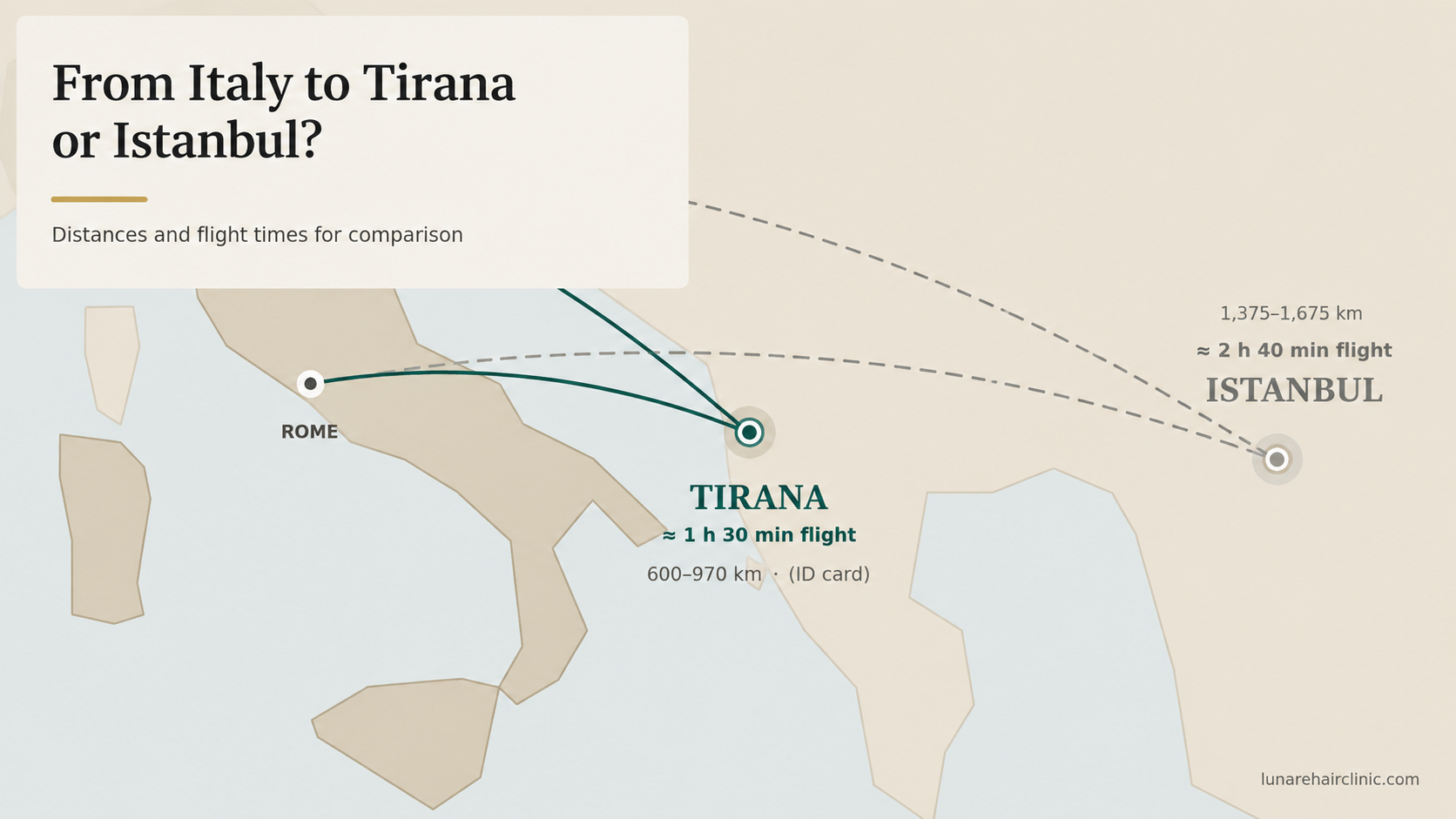
Tirana is about an hour and a half away from Italy by flight, with direct connections from Milan, Bergamo, Bologna, Pisa, Verona, Venice, Genoa, Rome, Naples, Bari, and Catania. Istanbul is between two and three hours away, with a time difference.
This isn’t a cosmetic difference. A short flight means you can visit in person before deciding, and it means a check-up months later is a realistic option rather than a second trip to organise. It also simply means a less exhausting post-operative return: after the surgery your scalp is swollen and sore, and three hours by air weigh more than ninety minutes do, worth factoring in if you’re weighing up a hair transplant in Turkey against Tirana.
You don’t need a passport to enter Albania: a valid ID card is sufficient. For Turkey, you need a valid travel document, according to the regulations in effect at the time of travel—always check on the Italian Foreign Ministry website before booking.
2. The specialist who performs hair transplant surgery
This is the point that determines the outcome, and it’s the one least discussed.
A hair transplant involves three phases: planning the frontal line and assessing the donor area, graft extraction, and implantation. In many high-volume centers, the doctor intervenes during the first phase and obtains informed consent, while extraction and implantation are entrusted to technicians. The practice isn’t illegal everywhere, but it radically changes the quality of the result: a high transection rate during extraction damages grafts that don’t grow back, and a poorly harvested donor area causes permanent damage.
The number of patients treated per day is the most reliable proxy you have. A facility that operates on thirty or forty people daily cannot guarantee the surgeon’s continuous presence on each one. Albanian practices generally work with lower volumes—this is a consequence of the market size, not a merit—and this makes it easier to verify who’s messing with your head.
Question to ask, in both countries: how many procedures are performed per day, and in which phases is the doctor physically present? If the answer is vague, you have your answer.
3. Language, communication and informed consent
Informed consent isn’t a form you quickly sign upon arrival. It’s the document that explains what can go wrong and what happens if it does.
In Albania, Italian is widely spoken for historical reasons and because of television: in many clinics in Tirana, you can speak directly with the healthcare staff in your language, not just with a sales coordinator. In Turkey, mediation almost always occurs through an intermediary who translates. The difference becomes clear when you have to ask an uncomfortable question—about the actual number of grafts, about a complication, about what happens if you’re not satisfied with the result.
4. Follow-up after returning
The transplant is completed on the day of the operation; the results are visible twelve months later. In between are the shock loss, the phase in which nothing seems to have changed, and the gradual regrowth.
Ask in writing: who will follow you for the next twelve months, how often, through which channel, and what the guarantee covers in the event of insufficient rooting. A “lifetime guarantee on hair bulbs” without a numerical threshold and an activation procedure is not a guarantee: it’s just a slogan.
Forum on the best hair transplant clinics: how not to be misled?
Before making a choice, almost everyone consults a forum or social media group dedicated to hair transplants in Turkey or Albania, looking for testimonials from people who have already gone through the experience. This is a good habit, provided you read them with the same critical eye you’ve used so far.
Be wary of recently created profiles that only post glowing reviews of a single clinic; instead, look for users with a more varied history of posts, photos taken at different stages of recovery, and a willingness to answer direct questions in the comments. The most useful reviews of hair transplants in Turkey are those that also mention the difficulties, not just the end result.
Comparison of hair transplant clinic costs: what are you actually paying for?
The table below compares the total cost of a transplant clinic, not the price of the procedure, for a typical procedure of 2,500 grafts/euro.
| Item | Italy | Türkiye (Istanbul) | Albania (Tirana) |
|---|---|---|---|
| Approximate cost of the procedure | 7.000 – 9.000 € | 2.500 – 3.500 € | 1.900 – 3.000 € |
| Cost per graft | 2,50 – 5,00 € | 0,90 – 2,00 € | 0,70 – 1,20 € |
| Round trip flight from Italy | — | 150 – 300 € | 80 – 200 € |
| Flight Duration | — | 2 – 3 h | ~1,5 h |
| Recommended overnight stays | — | 4 – 6 nights | 4 – 6 nights |
| Required document | — | according to current legislation | identity card |
| Typical waiting times | 6 – 12 months | 2 – 4 weeks | 2 – 4 weeks |
Three observations on the numbers.
The advertised price isn’t the final price. Many hair transplant in Turkey or Albania packages are marketed as “all-inclusive” while excluding post-op medication, PRP if recommended, and a possible second session. Ask for a quote that spells out in detail what’s included and what isn’t.
The price per graft only matters if the graft count is accurate. The most common trick in the industry is promising a certain number of grafts and then not delivering it: you pay for 4,000 units and only 2,800 get implanted, leaving the patient with no way to count them. A trustworthy quote starts with a reasoned estimate of your degree of hair loss, not a fixed-number package. This estimate is usually based on the Norwood scale, which classifies hair loss into progressive stages and assigns each one an indicative graft count — an objective figure that any serious clinic should be able to cite, rather than simply handing you a number out of thin air.
A price that’s too low is a clinical risk, not a bargain. Below a certain threshold, the only way to make ends meet is to cut something: the doctor’s presence, the time dedicated to you, the quality of the room. If a quote is drastically lower than all the others, the right question isn’t “why is it so cheap”, but “what have they cut?”
How can you spot the signs that a hair transplant clinic is not trustworthy?
They apply in Istanbul, Tirana, and Milan. If you recognize two or more, change the structure.
- The quote arrives without an assessment of your situation. If they send you a price after seeing a single blurry photo, they’re not evaluating: they’re selling.
- The number of grafts is promised before any examination. No one can seriously estimate the graft requirement without assessing the density and capacity of the donor area.
- You can’t speak to a doctor before paying the deposit. If your only contact is a sales coordinator, the doctor is just a detail in the package.
- The website doesn’t list surgeons, or it lists them without verifiable qualifications. Name, specialization, professional registration, membership in relevant scientific societies. If it’s missing, ask yourself why.
- The before/after photos have different lighting, angles, or angles. It’s the oldest trick in the industry. A credible case shows the same pose, the same lighting, and states the grafts and the number of months spent.
- A 100% guaranteed result is promised. No serious surgeon can guarantee an aesthetic outcome. A protocol can be guaranteed, a minimum success rate, and repeat operations under defined conditions. Not “100%.”
- The pressure to close is immediate. Discounts expire in 48 hours, “last minute” seats, deposits requested during the first call. Surgery is not a low-cost flight.
When Turkey remains the right choice
It would be dishonest not to say.
If your case is complex — advanced baldness with a compromised donor area, a reconstruction after a failed operation, a transplant requiring more than 4,500 grafts in multiple sessions — Turkey offers a concentration of surgeons with very high caseloads on that specific type of problem. The volume, which in other contexts is a defect, in these cases is accumulated experience.
The same applies if you have already identified a single Turkish surgeon with documented case history, publications and verifiable reviews over several years. A good surgeon in Istanbul beats a mediocre clinic anywhere. The point is not the country: the point is that that professional is truly identifiable, and that he is the one who operates on you.
When Albania Isn't the Right Choice for You
The opposite is just as true, and it’s worth pointing out. Even the best hair transplant clinic in Albania can’t help you in these cases.
If you’re looking for the absolute lowest price, you’re not in the right place. Lower prices exist, both in Albania and elsewhere, and they’re precisely those discussed in the previous section.
If your degree of baldness requires multiple, closely spaced sessions and complex, multi-year planning, consider a center with specialized expertise in extensive reconstruction, wherever it is located.
If you have ongoing conditions or therapies that require a multidisciplinary evaluation—coagulation disorders, immunosuppression, cicatricial alopecia, autoimmune scalp diseases—the priority is a comprehensive diagnostic process, not a procedure abroad. Discuss this with your dermatologist first.
If you’re not willing to follow the post-operative protocol—washing, medications if prescribed, and checkups at 3, 6, and 12 months—no clinic and no country can guarantee you a successful outcome.
The 10 questions to ask before signing
Copy and paste them into your first email. The responses will tell you more than any review..
- Who actually performs the extraction and implantation: the doctor or a technician?
- How many patients does the facility treat per day?
- What is the name of the surgeon who will operate on me, his specialty, and his professional registration number?
- How is the number of grafts estimated in my estimate?
- What happens if, upon awakening, fewer grafts are implanted than expected?
- What technique do you recommend for my specific case, and why that one and not another?
- What exactly does the package include, and what items are excluded?
- Who will follow up with me for the next 12 months, how often, and through what channels?
- What does the guarantee cover in the event of insufficient engraftment, what is the threshold, and what is the procedure?
- Can I speak to an Italian patient who was operated on by you at least a year ago?
If a structure completely addresses all ten, you’ve found a serious partner. If it becomes rigid on the ninth and tenth, you’ve saved time.
Frequently Asked Questions
Is surgery safer in Albania or Turkey? Safety doesn’t depend on the country but on the facility: medical authorization, presence of a doctor in the operating room, emergency management, and traceability of informed consent. Both countries have excellent centers, and centers to avoid. The criteria listed in this article apply equally to both.
How much do I save compared to Italy? The savings on the total—surgery, flight, and accommodation—are significant in both destinations. The difference in price between Albania and Turkey is smaller than you might think: the real variable is what’s included and who performs the surgery.
How many days do I need to stay? A standard surgery generally requires four or five days: arrival and pre-operative consultation, surgery, initial cleansing and check-up at the clinic, and return. For very extensive surgeries, the stay is extended.
Can I fly immediately after the surgery? In most cases, return home takes place after the initial cleansing and check-up at the clinic. Follow your doctor’s instructions: protecting the recipient area during the flight is important in the first few days.
Are online reviews of transplants in Turkey reliable? Read them carefully. Look for reviews with photos from months ago, verifiable names, and specific details (number of grafts, outcome, complications). Generic reviews concentrated within a few weeks are the opposite sign.
The criterion that counts
To sum it up in one sentence: don’t choose a country, choose a partner who agrees to be verified.
A center that tells you the surgeon’s name, explains why they recommend one technique over another, writes down what happens if something goes wrong, and puts you in touch with a patient who underwent surgery a year ago—that’s a center that’s betting on its reputation. It’s the only guarantee that truly matters.
If you’re considering Albania, the easiest way to start is with a preliminary assessment of your case: from there, you can determine how many grafts are actually needed and which technique makes sense, before even discussing price.
Your new hair begins with a free conversation.
Table of Contents

Androgenetic Alopecia and Norwood Scale: Stages, Symptoms and When to Intervene
How to recognise androgenetic alopecia, what each Norwood stage looks like and from which stage a hair transplant makes sense. Clear, sourced guide.

Hair Transplant in Tirana: A Practical Guide to Flights, Accommodation and How Many Days You Need
Once you have decided that a hair transplant abroad makes sense, medical doubts are usually cleared up quickly. It is the practical ones that hold
Hair Transplant Before & After: Month by Month
What a hair transplant really looks like month by month: shedding, shock loss, regrowth at 3-6 months and the final result at 12-18. With photo protocol.
FAQ
Am I a good candidate for a hair transplant?
Most patients with stable hair loss and a sufficient donor area are good candidates. During the online evaluation, our doctors will analyze your photos and medical history to confirm whether a transplant is recommended and which technique fits best.
Is the hair transplant painful?
he procedure is performed under local anesthesia. You may feel mild discomfort when the anesthesia is injected, but the surgery itself is usually well tolerated. After the procedure, you may experience slight tension or sensitivity, which is managed with medication.
How long does the procedure take?
Depending on the number of grafts, a hair transplant typically takes between 4 and 8 hours, including breaks and preparation
When can I go back to work?
Many patients return to desk work after 3–5 days. If your job is physically demanding or involves sun exposure, you may need a longer break. Our team will give you tailored advice.
What do you mean by “guaranteed results”?
By “guaranteed results” we mean that we stand behind our work with:
- clear, realistic expectations before the surgery
- a written aftercare plan
- structured follow-up to monitor your progress
In specific cases, if results are significantly below expectations despite correct aftercare, our medical team may propose additional corrective sessions or solutions.
Is Albania safe for medical tourism?
Yes. Albania has become an increasingly popular destination for medical tourism thanks to modern clinics, qualified doctors and competitive prices. At Lunare Hair Clinic we work with strict hygiene standards and offer full logistical support for your stay.
What’s the difference between FUE, FUT and DHI?
FUT (Strip method)
A strip of skin is removed from the donor area, then divided into follicular units.
Leaves a linear scar on the back of the head.
Usually allows a large number of grafts in a single session.
FUE (Follicular Unit Extraction)
Individual follicles are extracted one by one using a micro-punch.
No linear scar, only tiny dot scars, usually invisible with short haircuts.
Faster recovery and less post-op discomfort compared to FUT.
DHI (Direct Hair Implantation)
Uses FUE to extract grafts, but implantation is done with special implanter pens.
Allows very precise control of angle, direction and depth of each hair.
Particularly suitable for hairline design and detail work.
You can think of DHI as an “evolved” way of implanting FUE grafts, not a completely separate transplant method.
When will I see results?
Hair transplant results follow a clear timeline:
0–2 weeks: healing and formation of scabs
1–3 months: temporary shedding of transplanted hairs (normal process)
3–6 months: first new hairs start growing
6–9 months: visible improvement in density
9–12 months: final result in most patients
So you need patience: it’s a long-term investment, not an instant makeover.
Are the results permanent?
Transplanted hair is taken from areas genetically more resistant to baldness, so it usually keeps growing for life.
However, non-transplanted hair can continue to thin over time. That’s why stabilizing hair loss (with medical therapy when indicated) and planning a long-term strategy with your doctor is important.
What are the main risks or possible complications?
When performed by experienced doctors in a proper medical setting, hair transplant is generally safe, but as with any medical procedure there are potential risks:
Swelling and bruising
Temporary numbness or sensitivity
Infection (rare with correct hygiene)
Folliculitis (inflammation of follicles)
Suboptimal growth or density if aftercare instructions are not followed or if grafts are not handled correctly
A serious clinic will explain risks clearly and give you written post-op instructions.
 English
  Italian